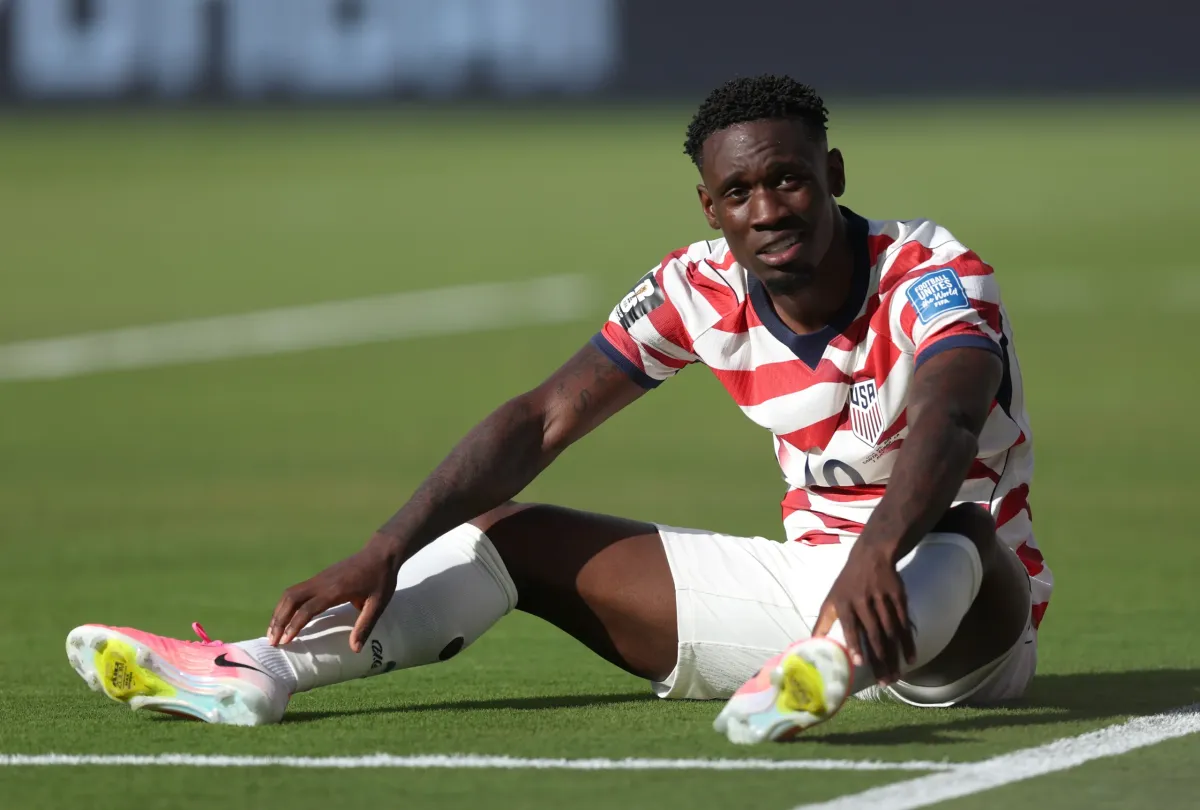
The United States men’s national soccer team enters its highly anticipated FIFA World Cup Round of 16 match against Belgium under extraordinary circumstances. While the return of star striker Folarin Balogun strengthens the American lineup, the decision to allow him to play has sparked widespread controversy, raising concerns about fairness, transparency, and political influence in world football.
The controversy began during the United States’ Round of 32 victory over Bosnia-Herzegovina, where Balogun received a red card following a challenge on a Bosnian defender. The referee on the field initially saw no foul, but after intervention from the Video Assistant Referee (VAR), the decision was upgraded to a red card. According to FIFA regulations, such a dismissal automatically carries a one-match suspension, meaning Balogun was expected to miss the crucial knockout match against Belgium.
The red card immediately became the subject of intense debate. Many questioned whether Balogun had intentionally made contact with the opponent, whether the VAR officials had correctly applied the rules, and whether slow-motion replays had unfairly exaggerated the incident. Critics also pointed to inconsistencies in officiating throughout the tournament, noting that similar challenges involving other players had not resulted in such severe punishment. Despite these concerns, the U.S. team initially accepted the suspension and prepared to face Belgium without their leading scorer.
However, the situation took a dramatic turn just one day before the match. FIFA’s disciplinary committee unexpectedly announced that Balogun’s one-game suspension would not be enforced immediately. Instead, it would be suspended under a one-year probationary period, making him eligible to play against Belgium. The committee released only a brief statement and did not explain the reasoning behind its decision, leaving many observers confused and skeptical.
Trump’s Intervention and FIFA’s Decision Spark Global Backlash Over Tournament Integrity
The controversy intensified further when reports emerged that U.S. President Donald Trump had personally contacted FIFA President Gianni Infantino after the Bosnia-Herzegovina match. Trump later confirmed that he had requested FIFA review Balogun’s suspension, describing the original red card as “very unfair.” His admission immediately fueled speculation that political pressure may have influenced FIFA’s decision.
This possibility alarmed many within the football community because FIFA’s own statutes require member associations to remain independent from political interference. Although FIFA did not respond publicly to questions regarding Trump’s involvement, the timing of the suspension reversal led many to question whether the governing body had compromised its commitment to neutrality and fair governance.
Belgium reacted with disbelief and frustration. Head coach Rudi Garcia sarcastically remarked that he thought July 5 had somehow become April Fool’s Day after learning of Balogun’s reinstatement. The Royal Belgian Football Association (RBFA) condemned FIFA’s decision, calling it astonishing and pledging to pursue every available avenue to challenge Balogun’s eligibility. Belgian officials argued that the issue extended beyond one match, emphasizing that they were defending the integrity, ethics, and credibility of international football itself.
The RBFA formally announced its intention to challenge Balogun’s participation regardless of the match’s outcome. It maintained that FIFA’s handling of the situation undermined confidence in the competition and threatened the principles of equal treatment and sporting fairness that govern international football.
The criticism extended beyond Belgium. UEFA, European football’s governing body, released a strongly worded statement asserting that FIFA had crossed a “red line.” UEFA warned that when governing bodies fail to apply rules consistently, the integrity of competitions suffers. It also argued that allowing Balogun to play created a dangerous precedent, as future disciplinary cases could now be subjected to similar intervention, potentially leading to inconsistent rulings throughout the tournament.
Several coaches from other national teams also voiced concern. Norway manager Ståle Solbakken described FIFA’s decision as a major mistake, questioning how future red-card cases would now be handled. He warned that overturning suspensions through extraordinary committee decisions would weaken confidence in the rules and damage the World Cup’s credibility.
Despite the widespread criticism, the U.S. team welcomed Balogun’s return. Head coach Mauricio Pochettino argued that the original red card had been an obvious officiating error and that justice had finally been served. He maintained that nearly everyone who reviewed the incident believed the punishment was excessive, making FIFA’s decision appropriate despite the controversy.
FIFA Suspension Controversy Overshadows High-Stakes U.S. Clash Against Belgium at World Cup
The Balogun case also drew comparisons to an earlier FIFA disciplinary decision involving Portugal star Cristiano Ronaldo. After Ronaldo received a red card during a World Cup qualifying match, FIFA similarly delayed the enforcement of his suspension, allowing him to participate in Portugal’s opening World Cup matches. Critics argued that this demonstrated an emerging pattern in which FIFA selectively delayed suspensions involving high-profile players, raising further questions about consistency and equal treatment.
Meanwhile, attention also remained focused on the sporting challenge awaiting the United States. Belgium entered the tournament ranked ninth in the FIFA world rankings, compared to the United States’ seventeenth-place ranking. The two teams had met in a friendly earlier in the year, with the Americans taking an early lead before Belgium dominated the remainder of the match and secured a convincing 5-2 victory.
U.S. defender Chris Richards acknowledged the previous defeat but expressed confidence in his team’s development throughout the World Cup. He emphasized that the Americans had learned valuable lessons from that earlier encounter and believed they were better prepared for the knockout stage.
A victory over Belgium would send the United States into the World Cup quarterfinals for the first time since 2002, marking the nation’s deepest tournament run in more than two decades. However, regardless of the result, Balogun’s eligibility is likely to remain a defining storyline. If the striker plays a decisive role in an American victory, questions surrounding FIFA’s controversial intervention, political influence, and the integrity of the tournament are likely to persist long after the final whistle.