For much of the season leading into the playoffs, Karl-Anthony Towns’ fit within the New York Knicks’ system was a subject of ongoing debate. His usage rate, shot distribution, post touches, and involvement in offensive sets were closely examined on a nightly basis. Critics questioned whether he was being utilized enough, whether the Knicks were failing to maximize his offensive versatility, and whether his partnership with Jalen Brunson could succeed in high-pressure situations. Some analysts pushed for Towns to adopt a more aggressive scoring mindset, while others argued the two stars lacked natural compatibility within the same offensive structure.
That uncertainty began to fade during the Knicks’ playoff series against the Atlanta Hawks, particularly after Game 3, when New York trailed 2–1. Head coach Mike Brown and his staff introduced key adjustments designed to simplify the offense and better align it with player strengths. One of the most important changes was positioning Towns higher on the floor, allowing him to initiate actions and read defensive coverages more dynamically instead of operating strictly as a finisher in the post.
Towns Transforms Knicks Offense Through Playmaking Defense And Crucial Tactical Adjustments
The impact of these changes was immediate. Towns became a more active playmaker, recording 10 assists in Game 4 alone. Over the final three games of the series, he averaged 8.7 assists and 11.6 rebounds, while posting two triple-doubles. His influence extended beyond box score production, as the Knicks outscored Atlanta by 62 points with him on the court during Games 4, 5, and 6. His presence helped stabilize New York’s offensive rhythm and opened opportunities for teammates through improved ball movement.
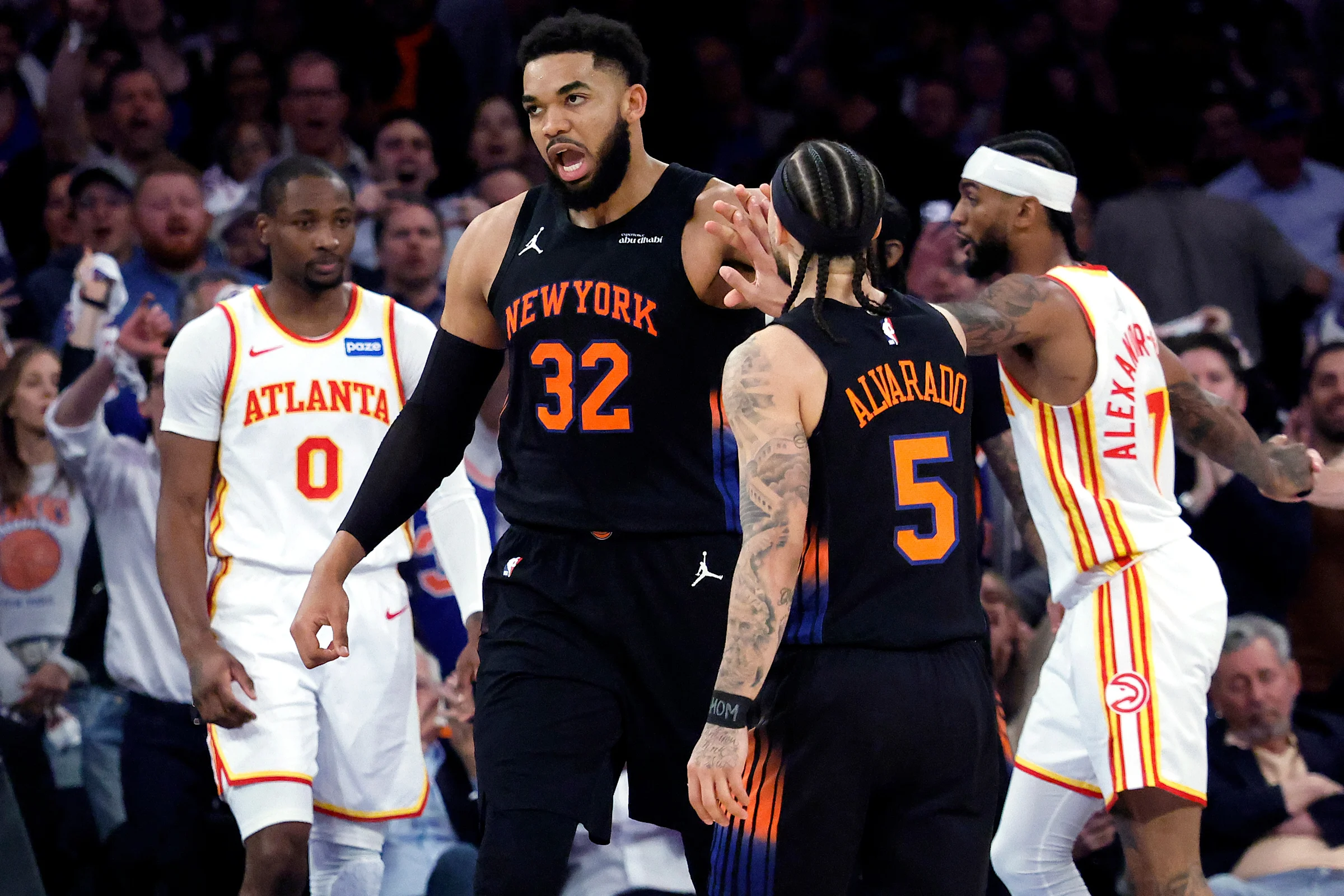
Jalen Brunson praised Towns’ performance and highlighted the growing trust between the two stars. He emphasized that the team’s collective confidence in each other had strengthened as the series progressed. Josh Hart also pointed to Towns’ defensive contributions in Game 6, noting his rim protection, energy, and commitment to executing the game plan at a high level. Towns delivered key blocks and provided a physical presence that helped disrupt Atlanta’s interior scoring attempts.
Earlier in the season, Towns had openly acknowledged uncertainty regarding his role within the Knicks’ offensive structure. However, he has since adapted to new responsibilities, embracing a more flexible approach. After Game 6, he explained that his mindset remained rooted in effort, sacrifice, and a willingness to adjust to whatever the team required. He emphasized that his focus has always been on contributing to winning, even when his role changes from game to game.
Mike Brown credited both his coaching staff and the tactical adjustments made after Game 3 as central to the Knicks’ turnaround. He stressed the importance of reducing offensive stagnation and empowering players to quickly recognize and exploit defensive advantages. Once the revised system was implemented, New York outscored Atlanta by 96 points over the remainder of the series, reflecting a significant shift in both efficiency and execution.
OG Anunoby shines as Knicks receive strong support from Bridges Hart efforts
While Towns’ evolution played a major role in the Knicks’ success, OG Anunoby emerged as one of the most impactful players in the series. He delivered consistent scoring efficiency, shooting at a high percentage from both the field and beyond the arc. His rebounding, defensive pressure, and timely scoring runs helped New York maintain control in key moments. In Game 6, his early scoring burst prevented Atlanta from building momentum and set the tone for the Knicks’ dominance.
Mikal Bridges also responded strongly in the closing game after a quieter start to the series. His efficient shooting and improved defensive intensity added balance to the Knicks’ wing rotation. Josh Hart continued to provide defensive stability throughout the series, particularly in his extended matchups against CJ McCollum. His ability to limit McCollum’s scoring and force turnovers became a valuable defensive asset for New York.
The series concluded with the Knicks displaying a more cohesive and adaptable identity. Offensive adjustments unlocked new dimensions in Towns’ game, while strong contributions from Anunoby, Bridges, and Hart reinforced the team’s depth. The combination of tactical flexibility, defensive commitment, and emerging star synergy positioned New York with renewed confidence moving forward in the postseason.