Categories
Football (Premier League)

Mourinho’s Fenerbahce triumphs 3-0 over Anderlecht in the Europa League playoff in Istanbul, while Porto and Roma finish 1-1
José Mourinho’s Fenerbahce may have just made it into the Europa League knockout playoffs, but it is now on the verge of reaching the round of 16.

Fenerbahce dominated Anderlecht 3-0 on Thursday, taking a strong lead to Belgium for the second leg next week. Meanwhile, two of Mourinho’s former teams, Porto and Roma, drew 1-1 in the competition.

Fenerbahce barely made it to the playoffs, finishing 24th in the new 36-team standings format, securing the last qualification spot on a tiebreaker based on goal difference. Anderlecht finished 10th, missing automatic progression to the last 16 due to goal difference.

Fenerbahce took the lead in the 11th minute. Anderlecht failed to clear a corner, and the ball was returned to the area where Yusuf Akçiçek headed it to Dusan Tadic, who scored with a header.

Edin Dzeko doubled the lead just before halftime. Filip Kostic made a good run down the left, and although Dzeko’s shot was blocked by Anderlecht defender Lucas Hey, the veteran forward fired the rebound into the net.

Youssef En-Nesyri added a third goal with a powerful header in the 57th minute, and Fenerbahce missed several opportunities to increase the score.

Yusuf Akçiçek’s header hit the post. It would have been his first-ever goal, after providing his first assist earlier in the match.

Dutch club AZ Alkmaar also holds a strong advantage going into next week’s second leg, having defeated 10-man Galatasaray 4-1.

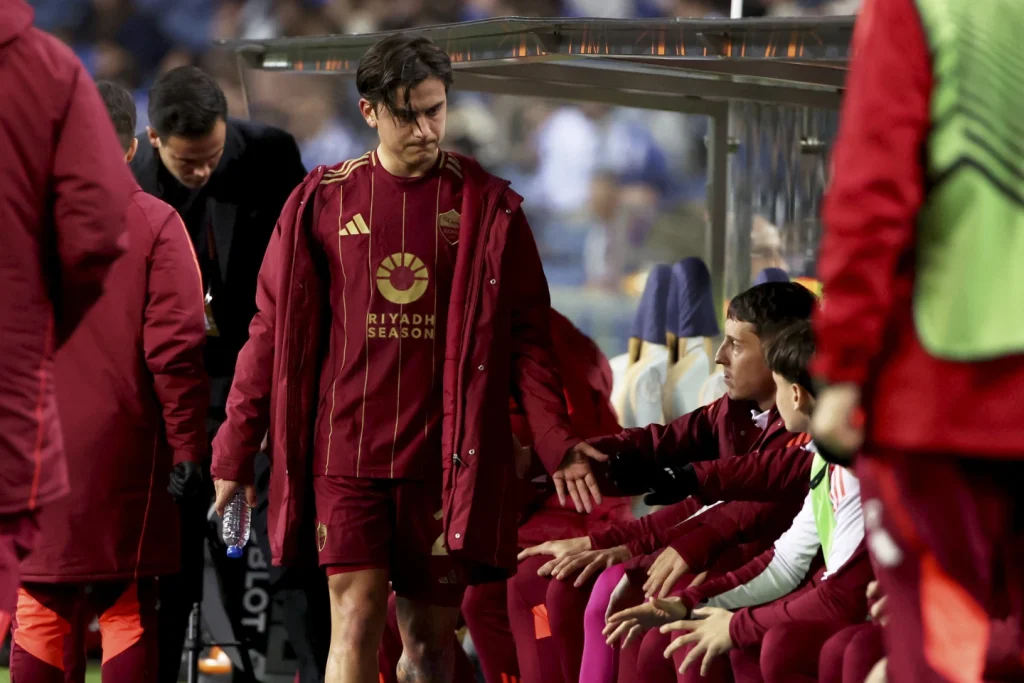
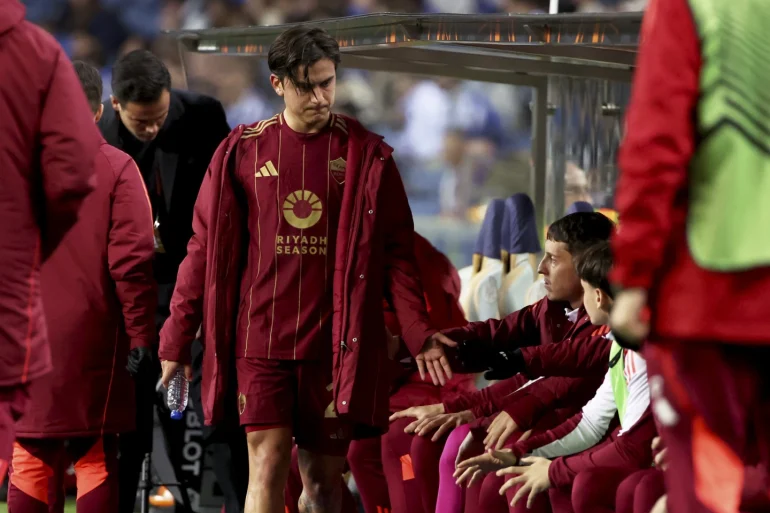
Roma’s key forward Paulo Dybala was injured in the first half of their match in Portugal, suffering a knee injury. Dybala screamed in pain after Porto’s Alan Varela’s boot hit his knee in the 20th minute. He continued playing for another 15 minutes but was forced to leave the field.

Roma took the lead just before halftime when Zeki Celik scored his first goal for the club. Porto equalized in the 67th minute with Francisco Moura’s deflected shot. Roma’s Bryan Cristante was sent off five minutes later after receiving a second yellow card.

Zeki Celik scores the opening goal

In another game, Ajax won 2-0 at Union Saint-Gilloise, with 16-year-old Jorthy Mokio scoring the second goal in the 71st minute. Mokio became the youngest player to score in a Europa League knockout stage match, at 16 years and 350 days old. Christian Rasmussen had scored the first goal for Ajax in the 59th minute.

In other results, Real Sociedad defeated Midtjylland 2-1, and Ferencvaros won 1-0 against Viktoria Plzen. FCSB came from behind to win 2-1 at PAOK, and Twente won 2-1 over Bodo/Glimt with a stoppage-time penalty.

Sixteen-year-old Michael Noonan made history by scoring on his Shamrock Rovers debut, helping the Irish team win 1-0 at 10-man Molde. Noonan, at 16 years and 197 days old, became the youngest-ever goalscorer in a European club competition. He scored in the 57th minute and also forced a red card for Molde’s Valdemar Lund, who fouled him as the last defender just before halftime.

Víkingur Reykjavík made history as the first-ever Icelandic club to win a European knockout match by beating Panathinaikos 2-1. The game was held in Helsinki as no stadium in Iceland met the required standards.

Armandas Kučys scored twice but missed a late penalty as Celje drew 2-2 with 10-man APOEL. Real Betis won 3-0 at Gent, and Jagiellonia won 3-1 at TSC.

European newcomers Heidenheim fought back to win 2-1 at Copenhagen, while Omonoia and Pafos drew 1-1 in an all-Cypriot match. Borac won 1-0 against Olimpija, despite having a late penalty saved.

Categories
Football (Premier League)

Zlatan Ibrahimović’s Rise From Street Football to Global Icon and Cultural Force

Zlatan Ibrahimovic is often portrayed in the media as a self-assured, dominant figure with a sharp tongue and an unrelenting will to win. His persona as an emperor of football, always proving doubters wrong, has overshadowed the complexities of his character. While his brashness is sometimes seen as arrogance, it is fueled by an all-consuming drive to succeed.

However, the mainstream portrayal of Zlatan often overlooks the deeper factors that shaped his journey, including his immigrant background and Sweden’s socio-political climate during his formative years.

The media’s tendency to focus on Zlatan’s charisma and larger-than-life persona ignores the nuanced experiences that made him who he is. Growing up in a broken home with divorced parents of different religious backgrounds—his mother, a Catholic Croatian, and his father, a Muslim Bosnian—he faced significant adversity.

His early years in Rosengård, a predominantly immigrant neighborhood, exposed him to hardship and instability. These experiences played a crucial role in shaping his resilience, work ethic, and defiant attitude toward challenges both on and off the pitch.

Zlatan’s childhood was far from idyllic. He moved between homes due to family troubles, at times living with his mother, who disciplined him harshly, and later with his father, who struggled with alcoholism as a result of the trauma from the Yugoslav Wars.

Growing up in an environment where kindness was rare, Zlatan resorted to aggressive behavior and petty crimes, such as stealing bicycles. His experiences reflect the struggles of many immigrant families in Sweden, where economic hardships and cultural differences created barriers to social integration.

Sweden experienced two significant waves of immigration from Eastern Europe, with Zlatan’s parents arriving before the Yugoslav Wars. Immigrants from the first wave found it harder to integrate than those from the second wave. Zlatan’s struggles with acceptance and integration in Sweden’s footballing system were a direct result of this.

He often felt different from his Swedish peers, not just in terms of his economic background but also due to his footballing style, which was influenced by street football rather than structured academy training.

Zlatan Ibrahimović
Zlatan Ibrahimović (AC Milan)

Zlatan Ibrahimović’s Journey From Street Football to Global Stardom Through Resilience

For Zlatan, street football was more than just a pastime—it was a survival mechanism. Street football, which has produced legends like Johan Cruyff, Pelé, and Eusebio, is known for its technical rigor and improvisational nature. Players develop exceptional ball control and spatial awareness because they learn to avoid falling on rough surfaces.

However, urbanization has significantly reduced spaces for street football, making it an increasingly rare breeding ground for top-tier talent. Zlatan’s upbringing in a working-class, immigrant-heavy neighborhood meant that he honed his skills in a setting where the game was played not just for fun, but as an escape from harsh realities.

As Zlatan transitioned from street football to organized clubs, he struggled with acceptance. At Malmo, where he played for an immigrant-based club before moving to the senior team, Swedish parents conspired against him, viewing his individuality and playing style as disruptive. He was frequently labeled as a troublemaker, reinforcing his outsider status. The discrimination and resistance he faced only strengthened his antagonistic approach to the game and his unwavering self-confidence.

One of Zlatan’s biggest inspirations was the Brazilian Ronaldo (R9), a player known for his technical brilliance and creativity. Like Ronaldo, Zlatan developed a playing style that combined physical dominance with exceptional technical skills, a rare trait for a player of his stature.

Unlike traditional target men, Zlatan adapted his game to fit different tactical systems across various leagues, evolving from a dribbler to a creative playmaker. His versatility became one of his defining traits, enabling him to succeed in leagues with contrasting styles, from the defensive rigidity of Serie A to the fast-paced nature of the Premier League.

Zlatan Ibrahimović
Zlatan Ibrahimović (AC Milan)

Zlatan Ibrahimović a Footballing Maverick in an Era of Tactical Evolution

During Zlatan’s rise, football was undergoing a tactical transformation. The early 2000s saw pragmatic managers like Jose Mourinho and Rafael Benitez emphasize defensive solidity and counter-attacking play. Strikers like Didier Drogba and Thierry Henry thrived in this era due to their adaptability and ability to exploit space.

In Serie A, where tactical discipline was paramount, Zlatan had to adjust his playing style under coaches like Fabio Capello, who emphasized balance and efficiency over flamboyance. Despite these changes, Zlatan maintained his individuality, proving that a player could be both an entertainer and a team player.

Today, football values strikers who can do more than just score goals. Players like Harry Kane, Karim Benzema, and Victor Osimhen have all incorporated elements of Zlatan’s playing style—dropping deep, linking play, and pressing aggressively. Zlatan was ahead of his time in this regard, seamlessly blending physicality with technical finesse. Despite his age and injuries, he remains influential on the pitch, demonstrating that football is not just about athleticism but also about intelligence and adaptability.

Beyond his footballing ability, Zlatan represents a socio-cultural shift in Sweden and the broader footballing world. His journey from an immigrant-heavy suburb to global superstardom mirrors the challenges faced by many working-class and immigrant children who use football as a pathway to success.

His story is a reminder of how football can reflect larger societal changes, and his legacy will always serve as a symbol of resilience, individuality, and unyielding determination. As football continues to evolve, Zlatan’s influence—both as a player and as a cultural icon—will remain a lasting testament to his extraordinary journey.

Categories
Football (Premier League)

Europa League and Champions League Recap: Amorim’s First Win, Hummels’ Heroics, and Key Results from Matchday 5

In Thursday’s Europa League matches, there were notable results, with some managers and players making significant contributions to their teams’ successes. Ruben Amorim celebrated his first win as Manchester United manager in a thrilling 3-2 victory over Bodo/Glimt at Old Trafford. Despite an early lead by Alejandro Garnacho and a two-goal first-half comeback by Bodo/Glimt, Rasmus Højlund scored a brace to seal the win for Manchester United. Amorim’s first victory came after a disappointing debut draw against Ipswich Town, marking a positive turn for the club under his leadership.

Meanwhile, Mats Hummels emerged as a hero for AS Roma in their 2-2 draw with Tottenham. Although he conceded a penalty early in the match, Hummels equalized for Roma in the dying moments of the game, scoring in stoppage time to salvage a point for the Italian side. The match had seen Son Heung-min’s early penalty for Tottenham and Brennan Johnson’s later goal to put Spurs in the lead. Hummels’ performance, including his vital goal, might prove to be a turning point for him and AS Roma after a difficult start to the season.

Europa League and Champions League Recap: Amorim's First Win, Hummels' Heroics, and Key Results from Matchday 5
Europa League and Champions League Recap: Amorim’s First Win, Hummels’ Heroics, and Key Results from Matchday 5

Jose Mourinho’s Fenerbahce also celebrated a significant win in the Europa League, coming back from a 1-0 deficit to secure a 2-1 victory against Slavia Prague. The team trailed due to goals by Edin Dzeko and Youssef En Nesyri in the first half but rallied in the second half to claim the win. This result was Fenerbahce’s second consecutive win in the group stage after their opening win against RSG, strengthening Mourinho’s squad’s position in the competition.

In the other matches, several teams faced mixed fortunes. AZ Alkmaar and Galatasaray played out a 1-1 draw, while Anderlecht and Porto also ended in a 2-2 draw. Athletic Club triumphed 3-0 against Elfsborg, and Besiktas suffered a 3-1 defeat to Maccabi. Other results included victories for teams like Lyon, Braga, and Real Sociedad, while Midtjylland and Lazio had disappointing losses at home. The group stage continues to produce exciting and unpredictable results, keeping fans and teams on edge as they vie for spots in the knockout stages.

The Europa League group stage also saw a number of teams scoring big wins, with Nice going down 1-0 to Rangers and Ferencvaros dominating Malmo with a 4-1 scoreline. In a more dramatic encounter, Tottenham and AS Roma’s 2-2 draw highlighted the tension of high-stakes games, while Fenerbahce’s comeback against Slavia Prague demonstrated the resilience that Mourinho’s team possesses. As the competition progresses, these results will have a significant impact on the teams’ hopes of advancing.

Europa League Round Results:

Match Result
AZ Alkmaar vs Galatasaray 1-1
Anderlecht vs Porto 2-2
Athletic Club vs Elfsborg 3-0
Besiktas vs Maccabi 1-3
Dynamo Kyiv vs Viktoria Plzen 1-2
Lazio vs Ludogorets 0-0
Qarabag vs Lyon 1-4
RFS vs PAOK 0-2
Braga vs Hoffenheim 3-0
FCSB vs Olympiacos 0-0
Ferencvaros vs Malmo 4-1
Manchester United vs Bodo/Glimt 3-2
Midtjylland vs Eintracht Frankfurt 1-2
Nice vs Rangers 1-4
Real Sociedad vs Ajax 2-0
Slavia Prague vs Fenerbahce 1-2
Tottenham vs AS Roma 2-2
Twente Royale vs Union SG 0-1