


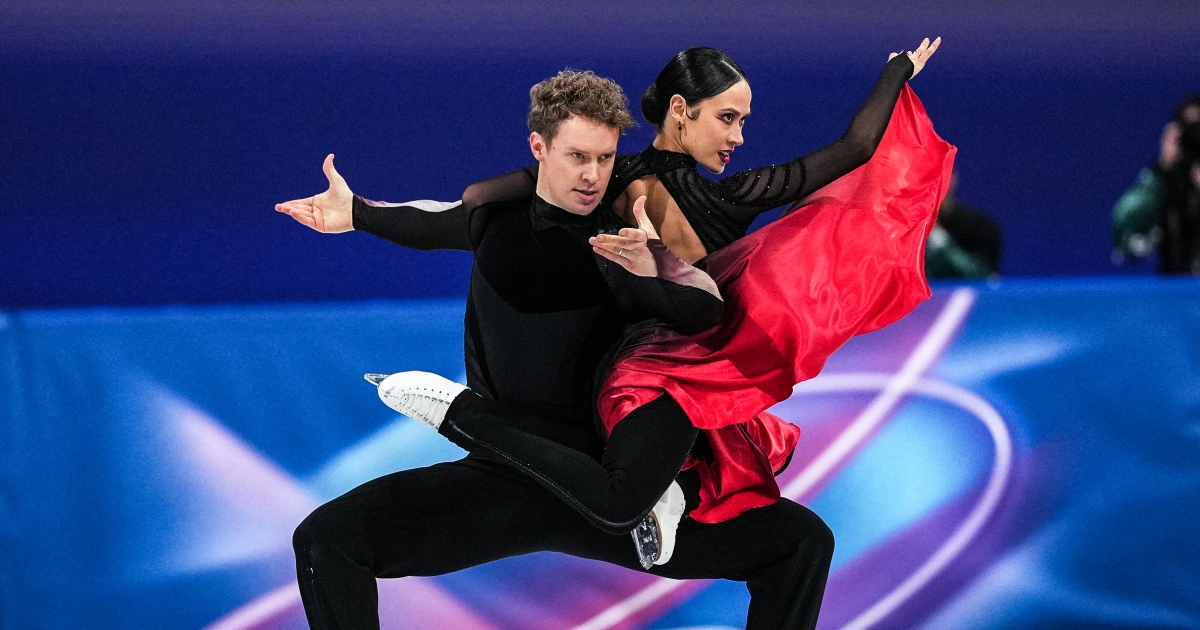
Madison Chock and Evan Bates achieved their best Olympic performance yet on Wednesday, earning a silver medal in ice dance at the Milano Cortina 2026 Winter Games. For the American duo, the medal was the result of years of dedication, rigorous training, and relentless focus, but it was also surrounded by controversy due to the sport’s subjective judging system.
Chock and Bates entered the Games as favorites after winning three consecutive world championships. Despite their international success, Olympic medals had eluded them, with previous finishes never higher than fourth place. Over the course of the week, they performed in four segments, including the team event, rhythm dance, and free dance, and their individual rhythm and free dances. Their performances were strong and consistent, yet discrepancies in scoring generated questions about fairness and highlighted the complexities of judged sports.
The rhythm dance took place on Monday and set the tone for the competition. Chock and Bates finished second to France’s Laurence Fournier Beaudry and Guillaume Cizeron, a recently formed pair that included a defending Olympic gold medalist. Among the judges, five of six who placed the French team first still scored Chock and Bates within 3.5 points. However, one French judge gave Cizeron and Beaudry a score 5.74 points higher than the Americans, creating a noticeable gap that left Chock and Bates trailing by 0.46 points after the rhythm dance. This narrow margin highlighted how minor differences in judging can decide medal positions.
Chock And Bates Deliver Strong Olympic Performance Despite Scoring Controversy And Intense Pressure
The free dance on Wednesday continued the theme of excellence mixed with subjectivity. Five of the nine judges awarded Chock and Bates first place, but two scores stood out. A Spanish judge ranked them third, while the French judge once again gave Cizeron and Beaudry a score 7.71 points higher than Chock and Bates. None of the judges who ranked the Americans first gave them more than a 4.1-point advantage. By the end of the free dance, Chock and Bates were 0.97 points behind the French team, leaving them 1.43 points short of the gold medal.
 Madison Chock And Evan Bates Achieve Olympic Silver Amid Scoring Controversy And Pressure
Bates acknowledged the challenges of competing in a judged sport. He said, “Life is sometimes you can feel like you do everything right and it doesn’t go your way, and that’s life, and that’s sport. It’s a subjective sport. It’s a judged sport.” Chock emphasized the pride she felt in the team’s performance, praising their ability to deliver four strong Olympic routines. She said, “Putting out four great performances at the Olympic Games is no small feat, and we’ve got a lot to be proud of.”
The French team’s background added another layer of discussion. Cizeron initially retired in 2024 but returned in 2025 with Beaudry, who had previously skated for Denmark and Canada. Beaudry became available after her former partner, Nikolaj Sørensen, faced a suspension that was later overturned. Cizeron has also faced accusations from former partners regarding controlling behavior, which he has denied. Chock and Bates have chosen to focus solely on their own skating, avoiding commentary on off-ice circumstances.
Despite finishing second, the silver medal represents a significant achievement for Chock and Bates. It validates years of preparation, sacrifice, and determination. For the first time, their Olympic performances reflected the level of dominance they have shown at the world championships. Chock described the emotional impact of her final skate: “There’s nothing more fulfilling than going out and performing your best and feeling like you have accomplished what you’ve trained for your entire career. To have that Olympic medal and that Olympic moment and feel like we had really done it, [we] felt that victory to our bones.”
Bates spoke about the relief of finally stepping away from months of intense preparation. He indulged in small pleasures that had been absent from his routine, including coffee and junk food. His comments showed the human side of athletes who spend months focused entirely on Olympic readiness and the sacrifices required to compete at the highest level.
Chock And Bates Showcase Skill, Resilience And Composure Despite Subjective Figure Skating Judging
The 2026 Games have highlighted the complexities of figure skating judging. Scoring depends on technical execution, artistry, and the interpretation of judges, which means that small variations can have significant consequences. While scoring gaps often create debate, the International Skating Union expressed confidence in the judging process. A spokesperson said that a range of scores is normal and that mechanisms are in place to reduce discrepancies, demonstrating their commitment to fairness.
Chock and Bates’ performance exemplifies resilience, professionalism, and composure in a sport where excellence does not always guarantee the top medal. They executed precise, technically demanding routines while maintaining artistic quality. Their silver medal is not just a reward for their performance but a testament to their skill, dedication, and ability to thrive under pressure.
Even amid debate over judging, Chock and Bates leave Milan proud and accomplished. Their Olympic journey demonstrates the balance required between technical mastery and the subjective nature of judged competition. It also shows the perseverance, focus, and emotional strength needed to succeed at the highest level. Their performances set a standard for future competitors and left a lasting mark on the sport of ice dance.