Categories
Football (Premier League)

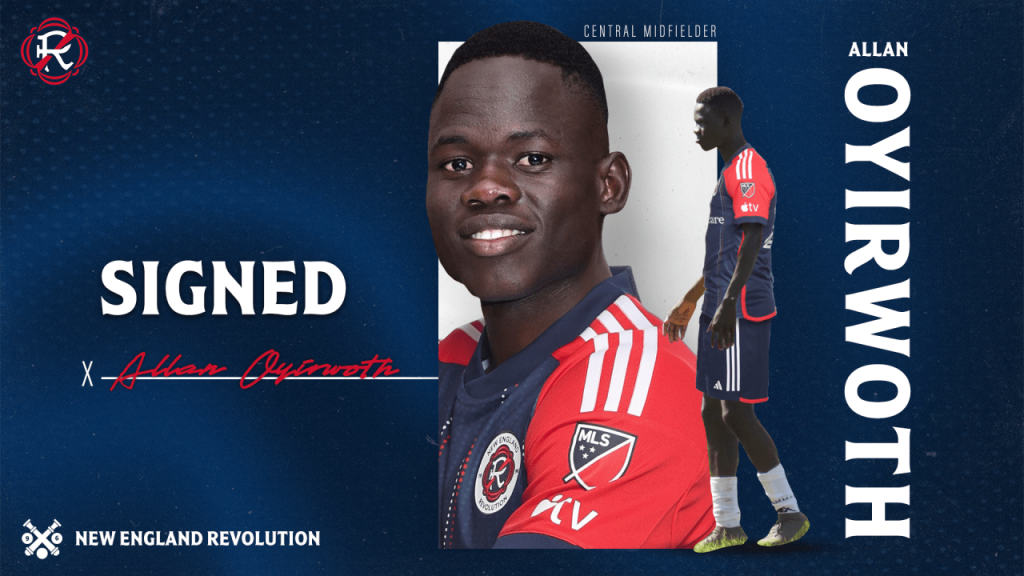
Revolution Sign Ugandan Midfielder Allan Oyirwoth in New England

The New England Revolution have signed 17-year-old central midfielder Allan Oyirwoth, who has experience with the Uganda Senior National Team. His contract will start on his 18th birthday, Jan. 23, 2025, and will run through the 2028 MLS season, with a one-year option for 2029.

Oyirwoth was born in Pakwach, Uganda, and has recently become a part of the Uganda National Team. He earned two caps for the senior team, starting with his debut on Nov. 21, 2023, in a FIFA World Cup Qualifier against Somalia, where he provided one assist in a 67-minute appearance.

His second game came in a friendly against Kuwait on Jan. 19, 2024. Oyirwoth also had a strong performance with the Uganda U-20 Men’s National Team at the 13th African Games in 2023, where he scored against Senegal and played in a 2-1 win over Nigeria.

“Allan Oyirwoth is one of the top prospects out of Uganda and a very promising young midfielder,” Revolution Sporting Director Curt Onalfo said. “We are excited to get Allan into our high-potential training environment in New England and help him fulfill his potential.”

Oyirwoth is the second-youngest player on the Revolution’s first team roster as preseason began this week. Before joining MLS, he impressed in Uganda with Amus College School and other clubs.

In March 2023, he was named the Teso Zone MVP after being the top scorer in the zonal school competition. In May, he was the top scorer and earned MVP at the USSSA National Football Championship, a 64-school tournament.

Alex Bono
Alex Bono (New England Revolution)

“Allan is a talented young midfielder with a tremendous upside and I’m excited to help him reach his potential,” Head Coach Caleb Porter said.

“At only 17, Allan is gifted technically and has a frame and range athletically that profiles well for MLS. With time to develop in our training environment, I’m confident he can blossom into an impact midfielder for our first team.”

In July 2023, Oyirwoth was the top scorer at the International Schools Football (ISF) Championship in Morocco.

The following month, he led the Federation of East African Secondary Schools (FEASSSA) competition in goals. His successful 2023 continued in October when he won the MVP award at the Buganda Masaza Cup while playing for Club Gomba.

He also earned MVP honors at the National Football Champions when his Amus College team finished as runners-up. In 2022, Oyirwoth was part of the winning teams at the East African Football Championship and the Ateker Cup.

After turning 17, Oyirwoth’s performances in Uganda earned him a move to Leicester, England, in February 2024, where he spent six months at the Brooke House College and Academy, a respected development program with connections to several English Premier League clubs.

Categories
FEATURED

The Gender Pay Gap in Professional Sports Highlights Persistent Inequality

The pay gap between men and women in professional sports is a stark disparity that has sparked controversy worldwide. Men earn significantly more than women, with the divide remaining around 80–84% since 2004. This gap mirrors the revenue differences between men’s and women’s sports, reflecting broader economic inequalities. According to the Bureau of Labor Statistics, women earn only 83% of what men make on average in the United States. Despite discussions and awareness, the gap in professional sports salaries has persisted largely unchanged for over a decade.

Male athletes in sports such as basketball, golf, soccer, baseball, and tennis earn significantly more than their female counterparts. While compensation structures vary by sport, the trend of inequality is universal across professional leagues. For instance, NBA players average over $10 million annually, compared to just over $113,000 in the WNBA. In golf, PGA players earn triple what LPGA players do, and in soccer, MLS players make nearly nine times the average NWSL salary. Tennis and ice hockey also reflect stark gender pay gaps. These figures illustrate the systemic undervaluation of female athletes’ work and contributions to their sports.

The Gender Pay Gap in Professional Sports Highlights Persistent Inequality

One factor contributing to this disparity is the lack of exposure and promotion for women’s sports. RHS Junior Giada Campiglia highlighted that women athletes are underrepresented in broadcasts and media coverage, limiting their marketability and revenue generation. This discrepancy forces many female athletes to work additional jobs to support themselves financially, a burden not shared by male athletes who earn more than enough to sustain their lifestyles. The economic imbalance perpetuates financial instability for female athletes, underscoring the urgent need for structural reforms in sports organizations.

The disparity in popularity and earnings between men’s and women’s sports is another critical issue. For example, in 2022, Naomi Osaka, the highest-paid female athlete, earned $51.1 million, significantly less than Lionel Messi, the top-paid male athlete, who made $130 million. Similarly, in soccer, the earnings from the women’s World Cup pale in comparison to men’s tournaments. In 2019, the U.S. women’s soccer league collectively earned less than the salary of a single men’s team, despite both teams achieving similar competitive success. Fans and activists have championed the cause for equal pay, but the gap persists.

Viewership statistics illustrate the growing interest in women’s sports, but financial rewards have not kept pace. For example, the U.S. Women’s National Soccer Team drew 14 million viewers during the 2019 FIFA Women’s World Cup finals, significantly more than previous tournaments. However, these gains in popularity have not translated into equitable pay. This inconsistency highlights the disconnect between audience support and financial recognition, emphasizing the need for sports organizations to reassess revenue-sharing models and compensation practices to promote gender equity in professional sports.