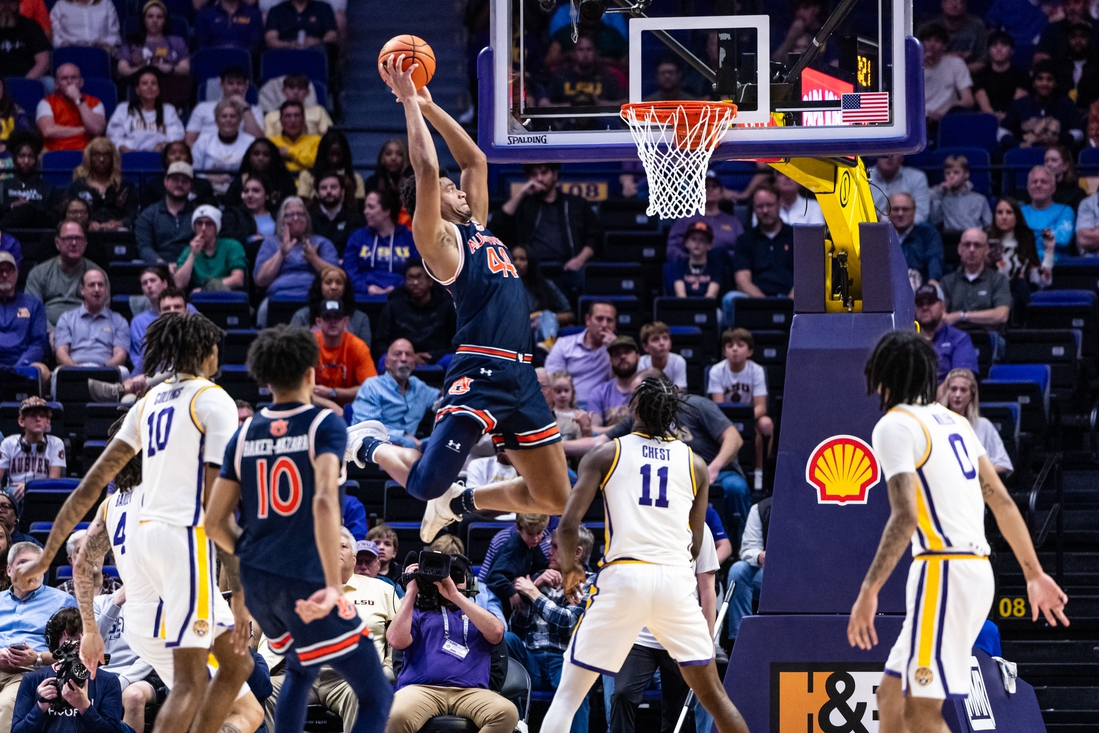
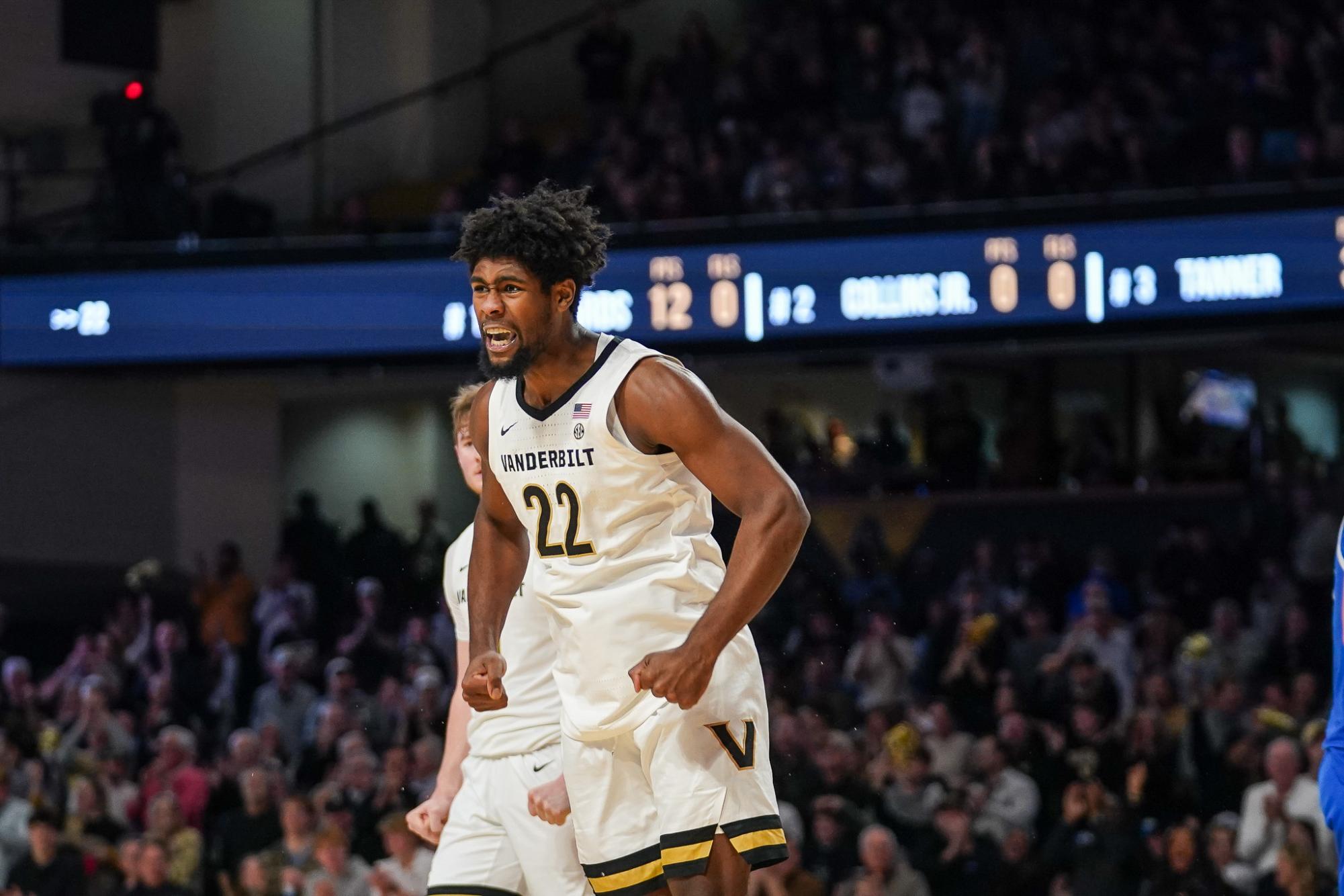
Johni Broome scored 26 points and grabbed 16 rebounds, leading No. 1 Auburn to a 87-74 victory over LSU on Wednesday night in Baton Rouge, La. This win marked Auburn’s 12th straight.
Miles Kelly contributed 13 points, Chad Baker-Mazara added 11, and Tahaad Pettiford scored 10.
Auburn (19-1, 7-0 Southeastern Conference) had an easier time in this game compared to their last three road wins, which were by two points (Georgia), three points (South Carolina), and five points (Texas). They built a 12-point lead by halftime and maintained at least a five-point advantage throughout the second half.
LSU (12-8, 1-6) was led by Cam Carter, who scored 24 points, Dji Bailey with 13, and Jordan Sears who added 11.
Auburn started the second half strong, with Denver Jones hitting a 3-pointer to make it 44-29. LSU responded with a 3-pointer from Carter and a putback layup from Corey Chest to cut the deficit to eight, but Auburn quickly answered with six straight points.
Sears made a four-point play and followed up with a 3-pointer, helping LSU pull within 55-50. Pettiford and Chaney Johnson both hit 3-pointers to increase Auburn’s lead to 63-52.
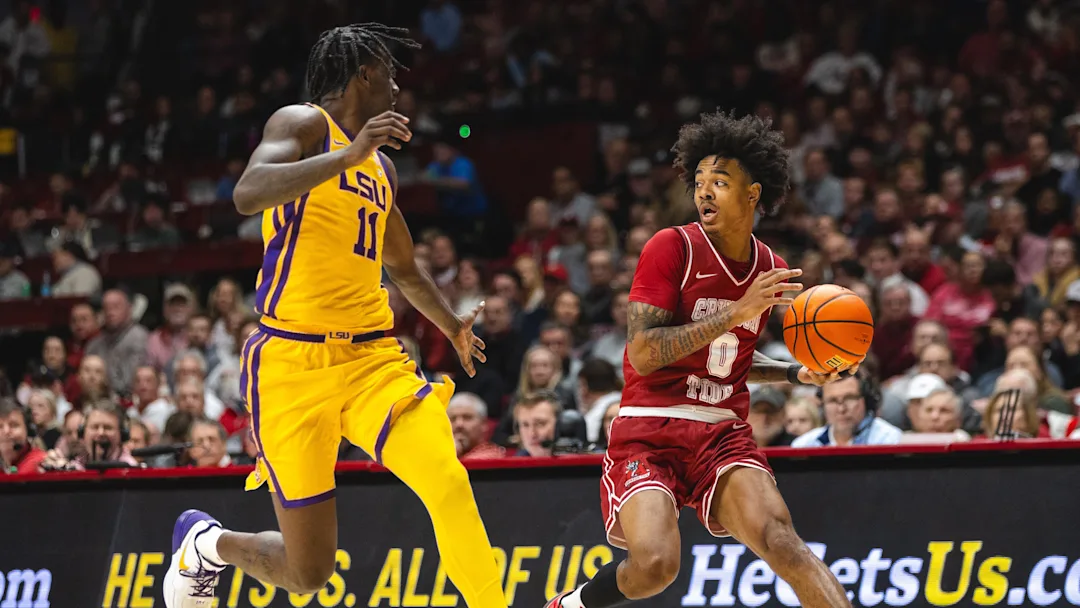
Alabama Crimson Tide guard Labaron Philon drives the ball against LSU Tigers forward Corey Chest during the first half
LSU managed to get within six points twice, but Broome scored four quick points to push Auburn’s lead to 77-66. LSU cut it to nine, but Johnson’s 3-pointer with 3:24 left put Auburn ahead by 12 again.
LSU started the game with the first six points, but Kelly’s eight points helped Auburn tie the score at 14. Jones’ layup tied it again at 16, and Auburn then went on a 12-0 run to take a 26-16 lead.
Sears’ layup broke a four-minute scoring drought for LSU, and Carter’s free throws brought the deficit to six. Baker-Mazara completed a three-point play, extending Auburn’s lead to 33-22.
Auburn reached its biggest lead of 13 points before heading into halftime with a 41-29 advantage. Their control of the game came in part from a 15-8 advantage in points off turnovers, as LSU committed 15 turnovers, and a 24-10 lead in points in the paint.
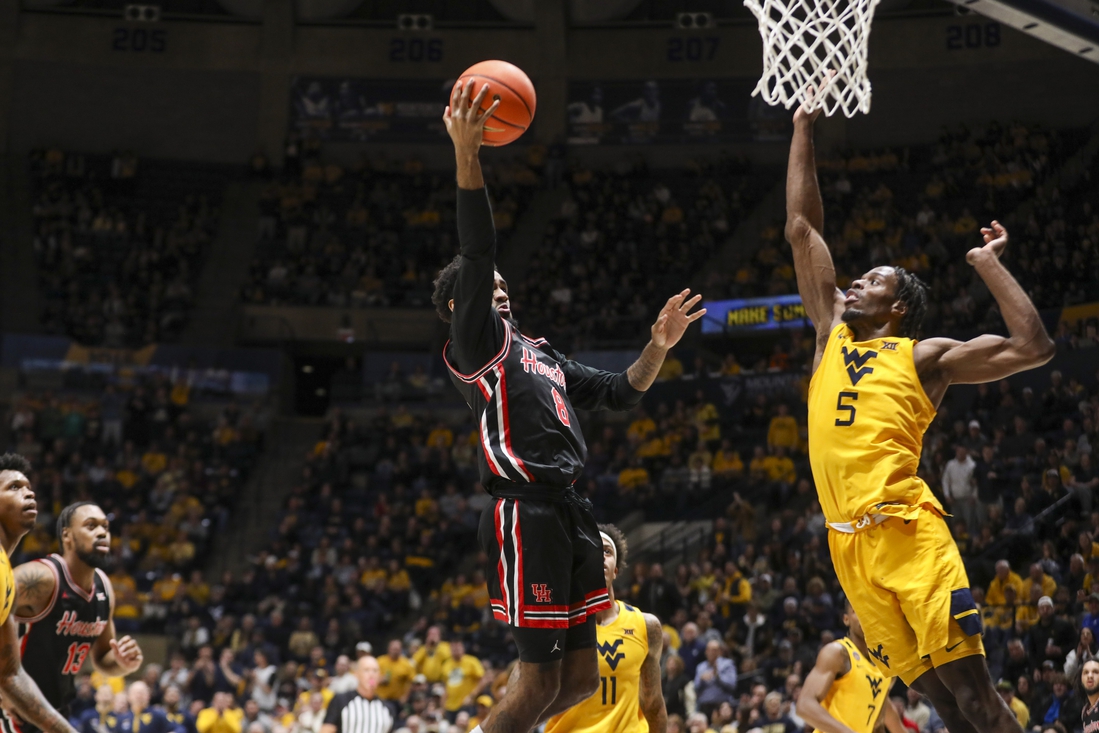
L.J. Cryer scored a game-high 17 points to help the sixth-ranked Houston Cougars hold off a second-half comeback by the West Virginia Mountaineers, winning 63-49 in Morgantown, W.Va., on Wednesday.
Houston (17-3, 9-0 Big 12) extended their winning streak to 13 games, even after nearly losing their 20-point halftime lead. Joseph Tugler added 12 points and seven rebounds, while Milos Uzan contributed 10 points. Despite turning the ball over nine times in the second half, which allowed West Virginia (13-7, 4-5) to rally, Houston held on.
West Virginia started the second half strong with an 11-0 run, including a 3-pointer from Jonathan Powell and a jumper by Toby Okani, which brought the score to 39-30. At the 13:39 mark, Sencire Harris made a steal and layup, and his free throw with 8:46 left pulled West Virginia within 47-42, the closest they had been in the second half.
The Mountaineers got within five points with under eight minutes remaining, but Cryer helped Houston push ahead by assisting on a dunk by Tugler and completing a three-point play following a goaltending call. Uzan hit a second-chance 3-pointer at 4:32, increasing Houston’s lead to 57-46. The Cougars turned 13 offensive rebounds into 16 second-chance points.
West Virginia (NCAAB)
Joseph Yesufu led West Virginia with nine points off the bench, while Amani Hansberry, Javon Small, and Okani each had eight. Despite shooting 57.1 percent in the second half, the Mountaineers struggled with free throws, missing five of nine attempts and hurting their chances of completing the comeback.
Houston quickly built a double-digit lead in the first half, with Emanuel Sharp hitting a 3-pointer for a 13-3 advantage. Small’s 3-pointer cut the deficit to 22-10 with 10:30 left, but West Virginia went another three minutes without scoring as Houston stretched their lead further.
J’Wan Roberts added a three-point play to give the Cougars a 27-13 lead, and two 3-pointers from Terrance Arceneaux helped Houston go into halftime with a 39-19 lead.
The Mountaineers struggled with turnovers in the first half, matching their eight turnovers with their total number of field goals. Houston shot 50 percent, made six 3-pointers, and had an eight-shot advantage in attempts.
North Carolina has long been a powerhouse in college basketball, and its fan base remains one of the most passionate in the country.
The Tar Heels have enjoyed a legacy of success, with six national championships, multiple Final Four appearances, and a history of legendary players like Michael Jordan, James Worthy, and Vince Carter.
However, as the program moves forward, many wonder if the fans are holding onto the past too tightly or if they are prepared to embrace a new era.
The success of North Carolina basketball over the decades is undeniable. Throughout the 1980s and 1990s, under coaches like Dean Smith and Roy Williams, the team became synonymous with excellence.
With a history of winning and dominating in the ACC, it’s no surprise that many fans are fiercely protective of that tradition.
For many, the days of Michael Jordan sinking clutch shots or the team’s memorable championship runs are cherished memories that cement the program’s place as one of the greatest in NCAA history.
These moments have shaped the identity of Tar Heels fans, and some are reluctant to let go of the past.
However, as the years go on, the game of basketball is evolving. The style of play is faster, with a greater emphasis on three-point shooting and a more open court. North Carolina’s program, while still strong, has faced challenges in keeping up with these changes.
Under new head coach Hubert Davis, the team has looked to adjust to the modern game while honoring the principles that have made the Tar Heels successful.
The recent trend of more teams focusing on recruiting players for one-and-done seasons has also affected how North Carolina builds its roster, as they typically prioritize recruiting players who stay for multiple years.
This shift has led to some mixed results, with fans questioning whether this approach will continue to bring success.
The North Carolina (NCAAB)
Davis has a sense of Loyalty
Supporters of the program’s future argue that the team is on the right path. Davis is a former player with deep ties to the school, and he’s instilled a sense of loyalty and pride in his players.
His leadership aims to blend tradition with innovation, ensuring that North Carolina stays competitive while adapting to the changing dynamics of college basketball.
Under his guidance, the team has had moments of success, and there’s a sense of optimism for the next generation of Tar Heels stars.
Yet, some fans remain nostalgic for the past. They long for the days when the team dominated the ACC with near-regularity and could count on its roster to feature future NBA stars.
The uncertainty of the program’s future leaves some feeling uneasy, as they wonder if the team can replicate the glory years or if they’ll fall behind other elite programs.
What many fans seem to forget is that the strength of a program doesn’t only come from its past but from its ability to evolve with the game.
While the success of previous decades should be honored and cherished, it is crucial to embrace change to keep the program relevant. The future of North Carolina basketball relies on balancing tradition with the flexibility to adapt.
As the season progresses, it’s clear that the fan base will continue to walk a fine line between honoring its storied past and supporting the new era of Tar Heels basketball.
While some may yearn for the glory of years gone by, others are eager to see what the future holds for the team.
What’s certain is that North Carolina fans, no matter their outlook, will continue to support their team through thick and thin.
The North Carolina Tar Heels have long been a college basketball powerhouse, known for their championship pedigree and history of producing NBA talent.
With six NCAA titles and a consistent reputation as one of the nation’s elite programs, the Tar Heels have been the gold standard in collegiate basketball for decades.
However, in recent years, it’s become increasingly apparent that their dominance may be slipping away. The question now is whether the Tar Heels’ glory days are a thing of the past.
The team’s rapid decline has been evident over the past several seasons, marked by early tournament exits, a lack of top-tier recruits, and struggles to maintain their elite status.
Under coach Hubert Davis, who succeeded Roy Williams in 2021, expectations were high for a smooth transition, but those hopes have not come to fruition as expected.
The 2022-2023 season, for instance, was a major disappointment. Despite having a roster full of seasoned talent, including key players like Armando Bacot and Caleb Love, the team failed to live up to its pre-season No. 1 ranking.
The Tar Heels missed the NCAA tournament altogether for the first time since 2010, marking a low point for a program that has long prided itself on its postseason presence.
With a program that was used to consistently competing for national titles, missing out on the tournament sent shockwaves through the basketball community.
One of the main factors contributing to this decline is the shifting recruiting landscape. For years, the Tar Heels were a major draw for the best high school talent.
Legendary coach Dean Smith’s legacy, combined with the team’s consistent success on the court, made it a destination for top players looking to shine at the highest levels.
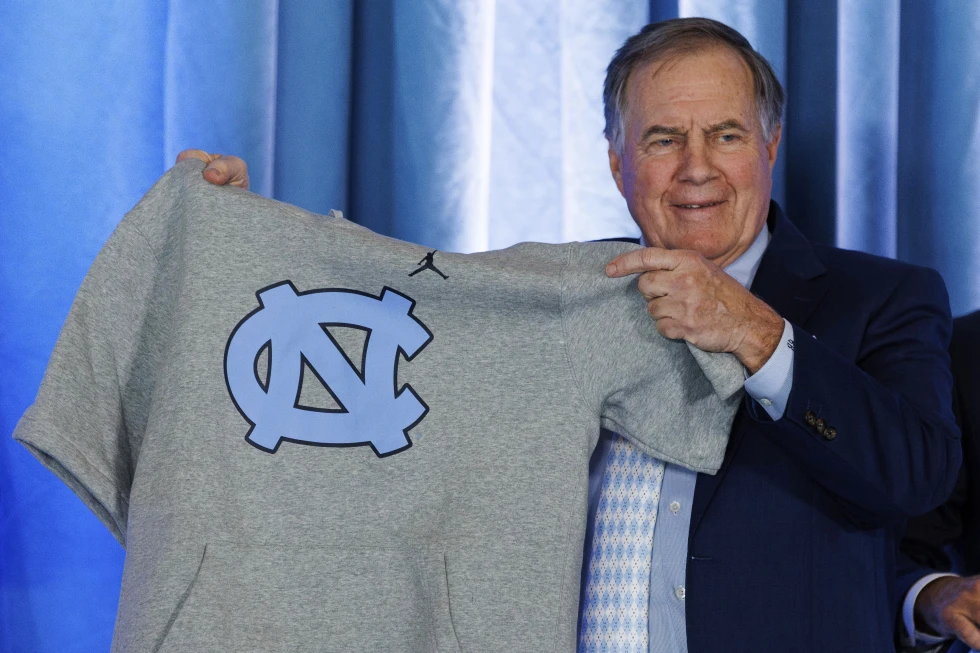
New North Carolina football coach Bill Belichick holds up a UNC-branded sleeveless hoodie presented to him during an NCAA college football news conference announcing his hiring
However, this is no longer the case. The rise of other programs, like Duke, Kansas, and Kentucky, along with the increasing dominance of programs such as Gonzaga and UCLA, has made it harder for UNC to secure top recruits.
In addition, the rise of the transfer portal has added another layer of difficulty, as it has given programs an easier way to replenish their rosters, leaving North Carolina scrambling to fill gaps.
Another critical factor is the loss of Roy Williams, who retired in 2021 after a Hall of Fame career at the helm of the Tar Heels. Williams’ leadership and recruiting prowess played an enormous role in maintaining the program’s elite status. His departure has left a significant void in both the team’s identity and the locker room.
Hubert Davis, although a former player for UNC, has yet to replicate the success Williams achieved, and his coaching style has struggled to inspire the same level of excellence.
The departure of key personalities is concerning
The loss of key figures like Williams and even players from previous championship teams also raises questions about the current state of UNC basketball.
Players who used to stay for multiple years now often leave after one or two seasons to pursue professional opportunities, especially with the increasing lure of the NBA.
This has left the team relying more on one-and-done players, who are less likely to have the level of chemistry and consistency needed to compete at the highest level.
UNC’s struggles to develop a winning identity in the post-Williams era have been compounded by the growing pressure from fans and alumni, who have grown accustomed to the team’s championship-level success.
The expectations placed on the program are immense, and when those expectations aren’t met, it creates a cycle of frustration and criticism that is hard to break. With the NCAA tournament now serving as the measuring stick for success, any failure to make a deep run results in widespread disappointment and calls for change.
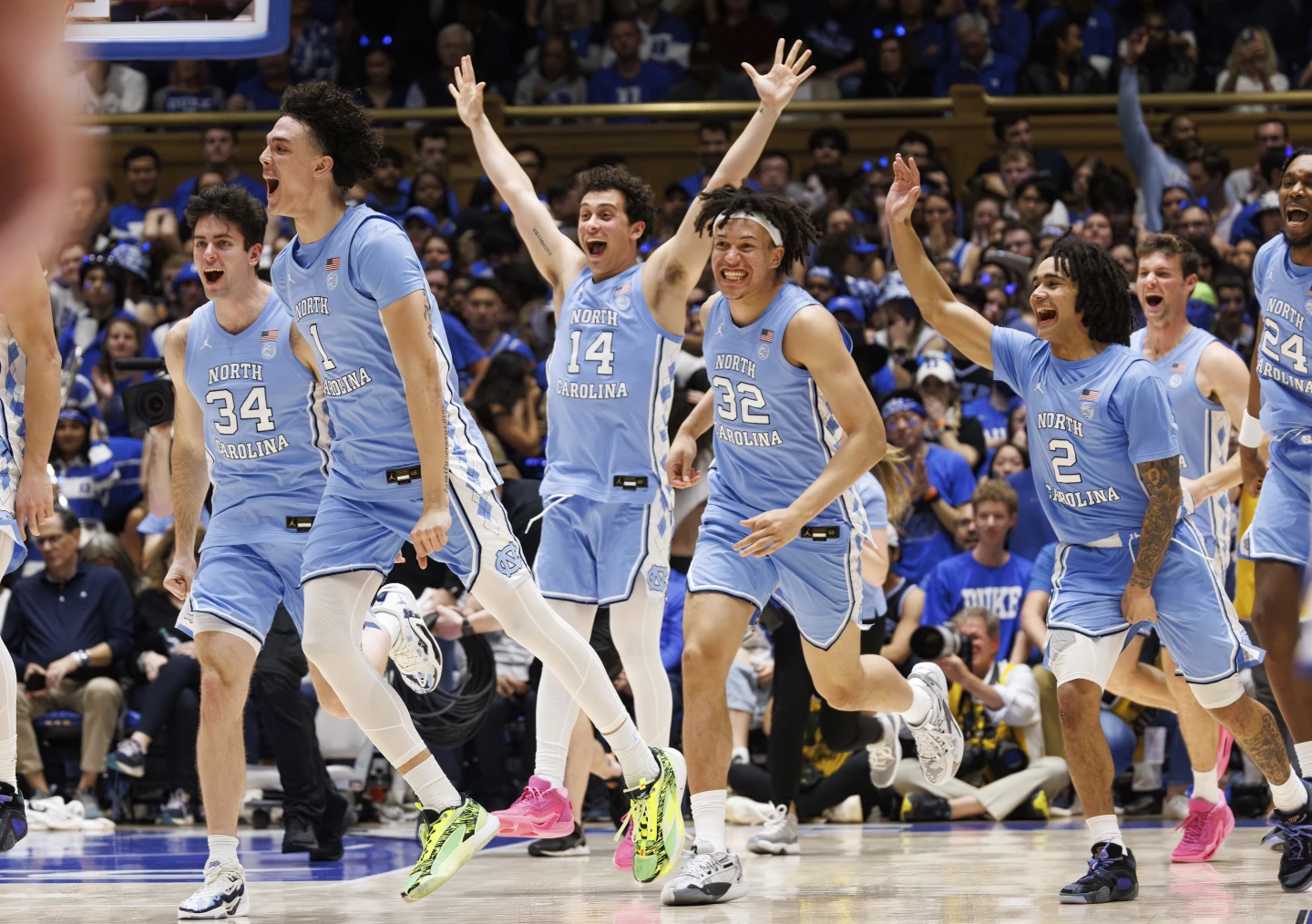
Duke vs. North Carolina (NCAAB)
Looking ahead, the future of UNC basketball appears uncertain. While the program will always have a rich history and loyal fanbase, the reality is that the current climate of college basketball presents significant challenges.
The increasing competitiveness of the sport, the changing dynamics of recruiting, and the mounting pressure on coaches have made it difficult for UNC to maintain its previous level of dominance.
Despite these obstacles, it’s not all doom and gloom for the Tar Heels. With the right adjustments, both in terms of coaching strategy and recruitment, the program could regain some of its former glory.
Hubert Davis, for instance, has already shown glimpses of potential with a few solid recruiting classes and a promising group of young players.
However, turning this ship around will take time, patience, and an ability to adapt to the rapidly changing world of college basketball.
For now, though, the Tar Heels are a far cry from the program that used to rule the college basketball scene.
With their recent struggles, it seems their era of dominance may have come to an end. The question remains whether they can rise to prominence once more, or if the glory days are truly a thing of the past. Only time will tell.
In Chapel Hill, UNC has been struggling more and more to secure top recruits, leading to a clear drop in the level of talent joining the team.
Even with its strong history and reputation, the Tar Heels are losing out to other big basketball schools, many of which can offer better opportunities.
UNC, once a leader in recruiting, now faces tough competition from schools with strong basketball programs and more appealing offers.
This makes it harder for them to bring in the high-profile players they used to attract. This situation has raised concerns about whether the program can keep its top status.
While the team still gets attention, the struggles in landing the best recruits are starting to show on the court. The gap is growing, and the Tar Heels are finding it harder to stay competitive nationally.
Hubert Davis has shown this side before—looking troubled, lost for words—but it hasn’t happened in a while. Probably not since his first season, when North Carolina was frequently on the losing side of large blowouts. Then came the surprising run in March 2022 that ended Mike Krzyzewski’s career, and suddenly that early-season Hubert Davis was nowhere to be seen.
Even though UNC has had some tough losses since then—like the 2022 championship game and last season’s Sweet 16 loss to Alabama—Davis hasn’t fully reverted to the way he was back then. He’s been upset at times, yes.
He wears his emotions on his sleeves. But he’s never been completely lost for words, unable to explain what went wrong.
That all changed on Tuesday night.
“It’s very head scratching,” Davis said in his postgame news conference. “I can’t explain.”
How could he explain? His team is now 6-5 for the season, but more importantly, 1-5 against strong teams. The 21-point comeback against Dayton in the Maui Invitational is a win that looks better over time, but it’s the only such comeback UNC has managed this season.
Against teams like Kansas, Auburn, Michigan State, Alabama, and Florida—five teams that are likely to make the NCAA Tournament, and teams North Carolina usually competes with—UNC has trailed by 20, 19, 14, 18, and 17 points, respectively. They lost all five games.
It’s a frustrating pattern for a coach, who might feel like he’s stuck in the same situation every time. “It’s just not sustainable, especially against good teams,” Davis said. “It just doesn’t work.”
And it hasn’t. Consider Tuesday night, when UNC fell behind by 10 in less than six minutes, quickly quieting the UNC fans in the Spectrum Center. By the nine-minute mark, Florida had made more 3-pointers (five) than North Carolina had made total shots (four).
Gators pushed to extend their lead
The undefeated Gators extended their lead from 10 to 14 to 17. With just under six minutes left in the first half, Florida was close to doubling UNC’s score, 35-18. UNC didn’t make its first 3-pointer until almost 16 minutes into the game.
Even then, Elliot Cadeau’s shot only reduced the lead to 12. It was starting to feel like the same thing we had seen in the previous five losses.
But whatever Davis said or did during halftime worked, because UNC came out looking like a completely different team.
Suddenly, they played better defense—like they had extra arms, the way they pressured Florida’s experienced guards. Seth Trimble and RJ Davis were especially key, making seven of UNC’s 11 steals and turning them into fast-break points.
In less than three minutes after halftime, UNC had gone on an 11-0 run and was just one point behind. “If we play the way we played the second half, and apply that for a full 40 minutes,” RJ Davis said, “it would be a different outcome.”
That’s what makes these big early deficits so confusing and frustrating. Neither Davis nor his players have an answer for why they keep falling behind. They know these slow starts are a problem, but it seems to happen every time.
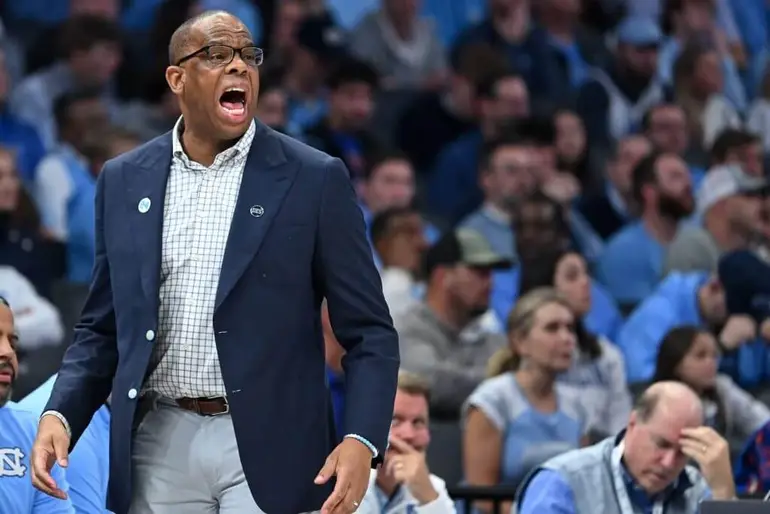
Hubert Davis (NCAAB)
How many more games will it take for something to click? Or, perhaps the scarier question is: What if this is just the way this UNC team is?
The slow starts aren’t the only major issue. They just make the other weaknesses even harder to overcome. For example, UNC’s size problems are well-known; the team starts three guards who are 6 feet 3 or shorter and has only two players in the rotation taller than 6-9.
This makes rebounding and defense harder. UNC’s defensive rotations were better against Florida, but no matter how hard they tried to contest shots, there was only so much they could do.
It was like an older brother shooting over his younger siblings in the driveway—what can you really do to stop that?
The same problem showed up on the boards. Florida is one of the best teams in the country at offensive rebounding, and it was no surprise that the Gators outrebounded UNC 46-36. Most importantly, it was the offensive rebounds that decided the game.
After UNC’s strong second half, the game turned into the exciting back-and-forth everyone had hoped for. UNC briefly took the lead for the first time since being ahead 2-0, after a Trimble and-one with just under eight minutes left.
Four minutes later, Cadeau—who had seven of the team’s 10 total assists—threw two perfect passes to RJ Davis and Jalen Washington, putting UNC ahead 81-77.
Florida called a timeout with 4:03 left. In the huddle, Hubert Davis clapped and said two things over and over: “Get a stop! Get a rebound!”
But that didn’t happen
Coming out of the timeout, UNC had the same momentum shift as before—except this time it went the other way. The key moment came with the score tied at 84 and under a minute left. UNC forced Florida’s Alijah Martin into a tough jumper, but he missed.
Unfortunately, 6-foot-4 guard Will Richard grabbed the offensive rebound and scored on his second attempt, putting Florida ahead.
On UNC’s next possession, RJ Davis missed a 3-pointer, and Florida grabbed another offensive rebound that led to two free throws. The game was effectively over.
In the final 4:03, Florida had seven shots to UNC’s three, four offensive rebounds—turning those into eight points—and made all eight of its free throws. Meanwhile, UNC went just 1-for-4 from the line.
“Who wanted the ball more when the ball got in the air? That was them, kind of the whole game,” Trimble said. “We had stretches where that was us, but that was them the whole game—and especially in those last four minutes.”
Florida finished the game with an 8-0 run, while UNC didn’t score at all in the final 2:13.
“That’s our next step as a team, as a unit, as individuals,” said freshman guard Ian Jackson, who helped spark UNC’s second-half comeback with a 6-0 run of his own. “Figure out how to start and finish the whole game.”
That sounds good. That sounds possible.
But what does the evidence show?
It’s still early, but 11 games in, it’s already clear that this season is well underway. Most of the nonconference games are done, and ACC play has started. There’s still time, but what has UNC really shown so far this season?
Not much, except for their pattern of slow starts, poor finishes, and the occasional moments of good play.
This looks like a team that’s closer to the NCAA Tournament bubble than one with any chance of making a real impact nationally, or even in a weaker ACC.
It’s too early to say that UNC is stuck in this pattern, but they haven’t shown anything to suggest otherwise.
“We’re too far into the season just to continue to show flashes of how good we can be,” Trimble said. “It’s time to do it. No more flashes.”
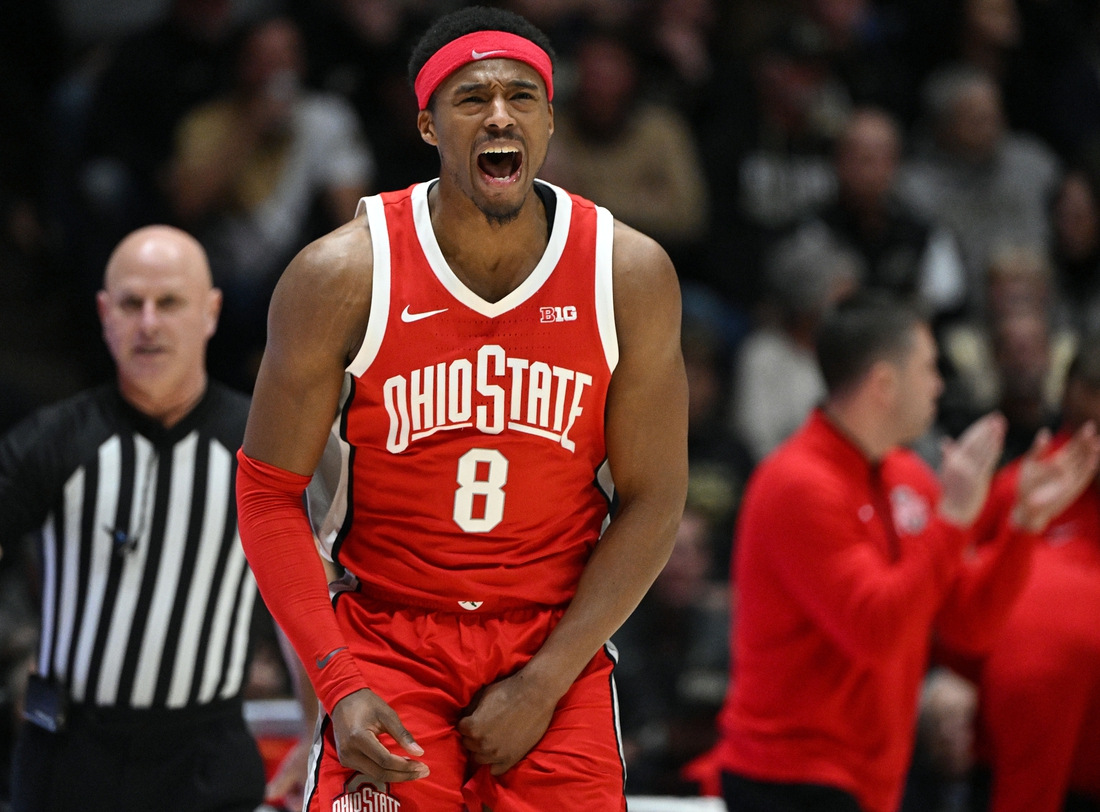
After a road win over No. 11 Purdue, Ohio State coach Jake Diebler is grateful for the break before hosting Iowa on Monday in Columbus. The Buckeyes (11-8, 3-5 Big Ten) have played five straight one-possession games, and Diebler believes this break will help the team recover and improve.
The win over Purdue ended a three-game losing streak for Ohio State, while Iowa (13-7, 4-5) snapped its own three-game slide with a 76-75 win against Penn State on Friday. The Hawkeyes now face a quick turnaround before playing Ohio State.
“Iowa senior Payton Sandfort, who averages 16.2 points per game, said, “When you’re going through a tough stretch, it can feel impossible to get a win.
Once you get one, things start to feel better. You feel like you can compete. You feel like we’ve got all the confidence in the world that we can go out and compete with Big Ten teams.”
Drew Thelwell, who scored 16 points for Iowa, reached 1,000 career points in the win over Penn State. “I’m thrilled for him,” said Iowa coach Fran McCaffery. “It’s an incredible accomplishment. It’s really hard to do. It says a lot about who he is.”
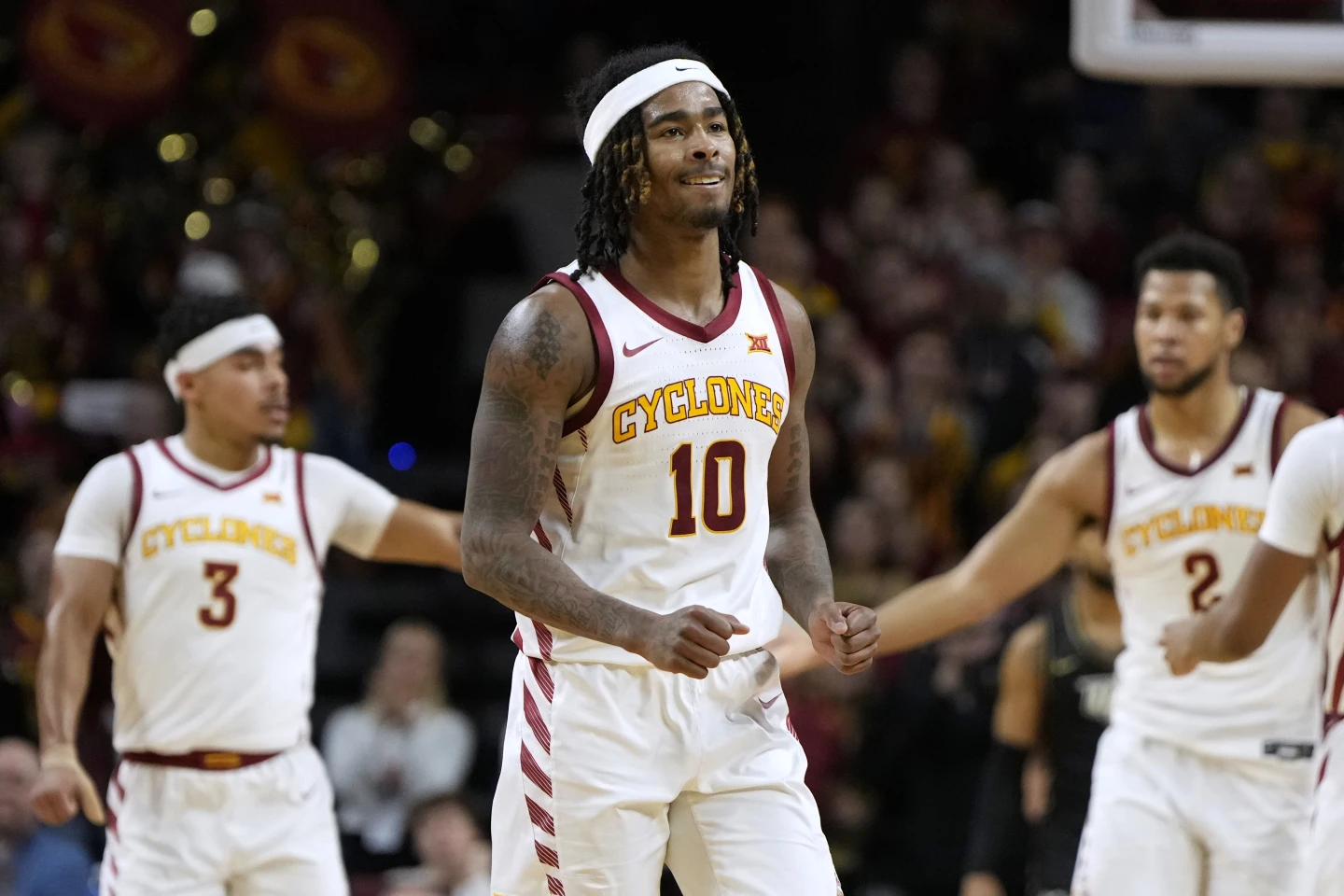
Iowa State players celebrate after scoring
Ohio State showed resilience in the Purdue win, coming back from a 16-point deficit. Micah Parrish led the way, scoring 17 of his 22 points in the second half. Parrish is in his first season with Ohio State after two years at San Diego State. He is fourth on the team in scoring, behind Bruce Thornton (17.1), Devin Royal (13.9), and John Mobley Jr. (12.3).
Diebler added, “We just always felt like there was more to his game than what he got to do, but that can be uncomfortable for guys at times, too. He’s used to doing things a certain way for a couple of years, and then you’re in a whole new system.”
Wake Forest faced a tough challenge over the weekend against No. 2 Duke. Now, it faces another tough matchup on Tuesday night as it travels to play No. 25 Louisville in an Atlantic Coast Conference game.
“The games are coming at you in rapid-fire here,” said Wake Forest coach Steve Forbes. “But it’s a great opportunity, right? It’s a great opportunity to get an unbelievable road win. And so that’s how we look at it.”
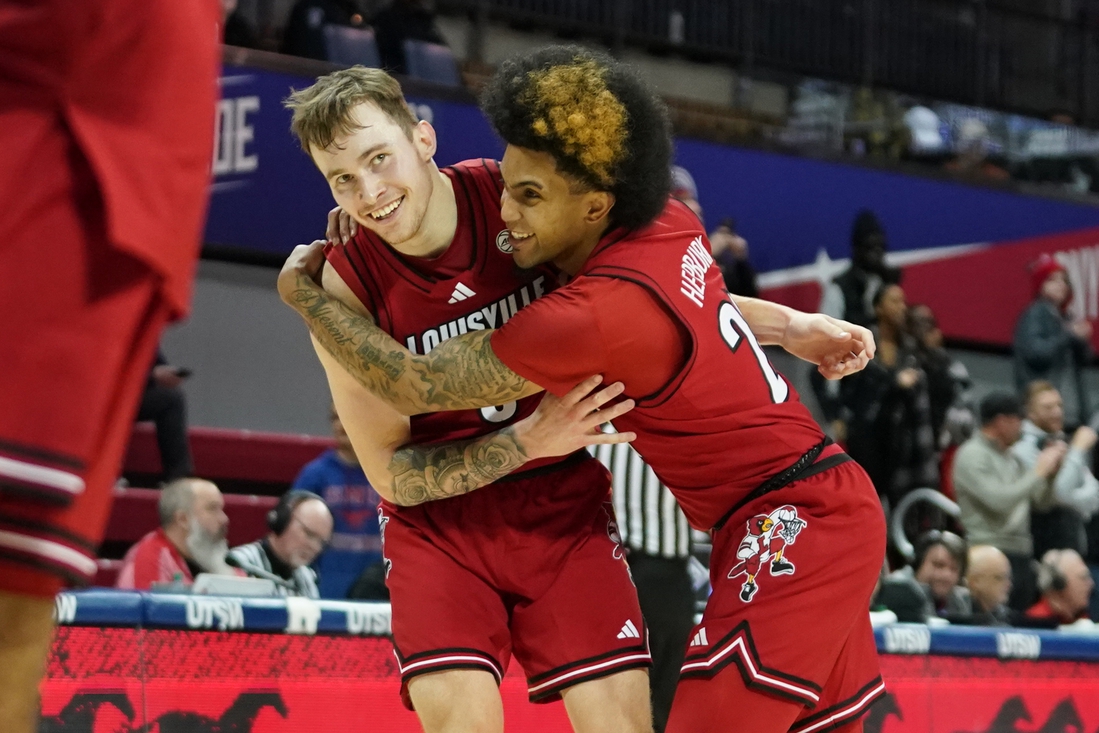
Louisville (15-5, 8-1) is riding a nine-game winning streak. The Cardinals had the weekend off and last played on Tuesday night, easily defeating SMU 98-73.
“I love playing with this team,” Louisville guard Chucky Hepburn said. “We’re coming a long way. We still have a lot of room to grow.”
Wake Forest (15-5, 7-2) saw its six-game win streak end with a 63-56 home loss to Duke on Saturday.
Four of Louisville’s past six wins have come by double digits, making early season setbacks seem distant.
“One thing that I love about this team is we never gave up,” Hepburn said. “If we lost, it was the next day, we were practicing, and we were just getting to it.”
The Cardinals have been playing well, with impressive teamwork. In last Tuesday’s game, they assisted on all 14 of their first-half baskets.
By the end of the game, Reyne Smith had set a school record with 10 three-pointers.
Hepburn, a senior transfer, set a career high with 16 assists, a new program record, and the most assists in an ACC game in nearly 14 years.
Duke dominates with top-five offensive and defensive efficiency (Duke)
Louisville coach Pat Kelsey called Hepburn’s performance “a magical game.”
Despite the loss to Duke, Forbes believes his team is still strong.
“We got a good basketball team, and we could pretty much play with anybody,” he said. “I’ve never been discouraged with this group of guys because they fight and they play so hard and they’ve learned that no matter how the offense is going, the defense keeps us in the game.”
Wake Forest is getting solid contributions from guard Juke Harris, a freshman who scored 14 points off the bench against Duke.
“He plays without fear, good and bad sometimes,” Forbes said. “But I’d rather have to dial somebody down and dial ’em up. And he’s competitive and fearless.”
However, Wake Forest is struggling with its offense and needs to improve execution.
“We just didn’t execute offensively when we needed to… and that cost us,” Forbes said.
Despite coming back from a 13-point deficit, Wake Forest was unable to break through against Duke’s switch to a zone defense. Forbes emphasized the need to work on better attacking tactics for the next time they face a zone.
“I just don’t think we executed the looks like we needed to do,” Forbes said. “It’s just we weren’t really crisp in what our executions should have been for the look that we should have got.”
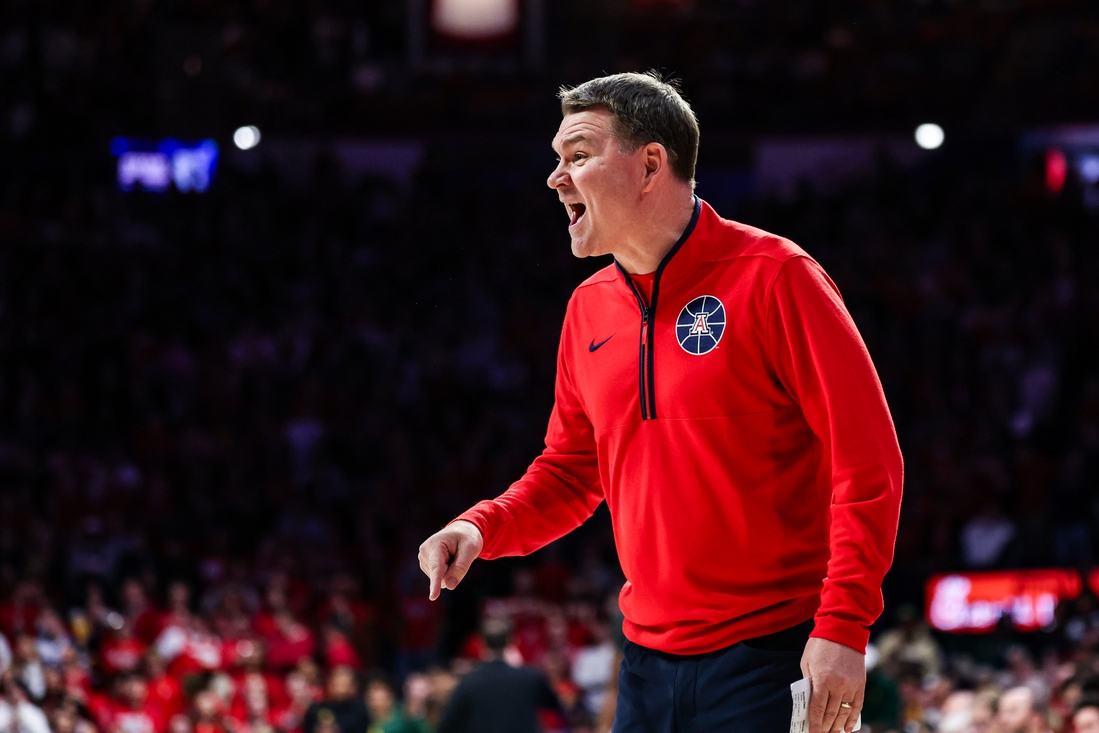
Tommy Lloyd of Arizona and T.J. Otzelberger of No. 3 Iowa State will face each other for the first time on Monday night in Tucson, Ariz. Both coaches began their successful careers in 2021-22 and have reached impressive milestones.
Lloyd recently earned his 100th career win in the fastest time for an active head coach, accomplishing it in just 126 games. His current record stands at 101-26 after a 78-63 win over Colorado on Saturday.
Otzelberger, with a record of 87-37 at Iowa State, has an overall coaching record of 186-100, with past coaching experience at South Dakota State and UNLV.
The Cyclones (17-2, 7-1 Big 12) are coming off a strong 76-61 win against Arizona State on Saturday, dominating the second half with a 43-21 run.
Arizona (13-6, 7-1) had a close first half against Colorado, leading 33-31, but pulled away for the win.
Lloyd acknowledged that Monday’s game isn’t the season’s make-or-break moment but sees it as an important opportunity. He emphasized the need for his team to earn their chance at winning the Big 12.
Arizona’s recent success can be attributed to key role players like guard Anthony Dell’Orso and post player Henri Veesaar. Veesaar has averaged 10.2 points and 4.2 rebounds in the past five games, while Dell’Orso, a transfer from Campbell, scored a career-high 20 points, including six 3-pointers, in the win against Colorado.
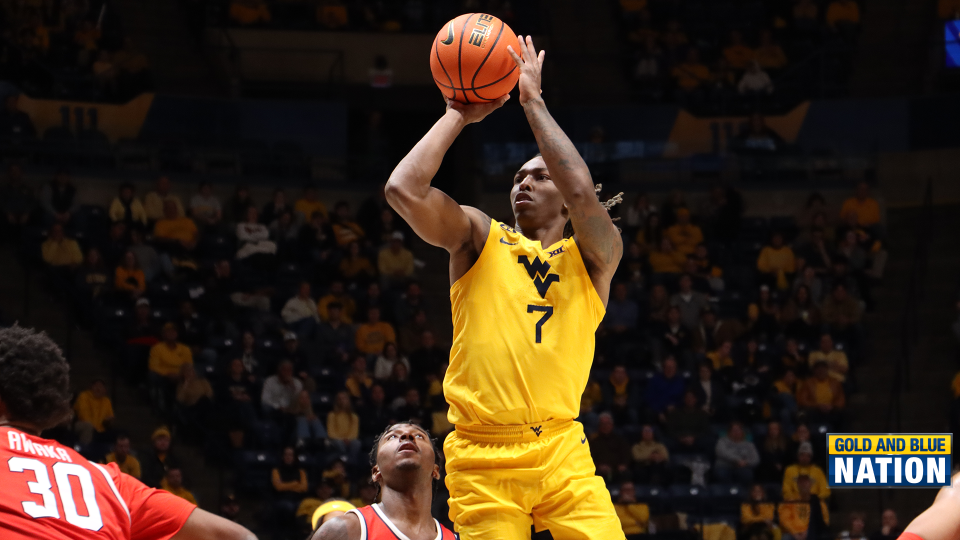
Javon Small pulls up for a mid-range jumper in the second half of WVU’s 75-56 loss to Arizona
“I’ve told Delly all along, ‘You’ve got to stay locked in and ready because there’s gonna be nights where I need you to be our leading scorer,’” Lloyd said.
Iowa State’s Curtis Jones led the Cyclones with a career-high 33 points, seven rebounds, and three steals in their win over Arizona State.
Joshua Jefferson added a double-double with 13 points, 10 rebounds, and four steals. Jones scored the final five points in a 19-3 run to seal the game after scoring 18 points in the first half.
“I feel like I’m always looking to be that aggressive at all times, whether we’re struggling or not,” Jones said.
With just one day between games, both teams will face a quick turnaround, unlike the usual two-day break between Big 12 games.
Lloyd views this quick prep as a valuable test ahead of March, stating, “We’ve got a really, really, really good team coming in on Monday, a top-five team, and it’s going to be a really good challenge for us to see where we’re at.”
Otzelberger didn’t focus on the similarity to the NCAA Tournament schedule, saying, “We just look at it as this is the job that we have in front of us, and we need to prepare for this opportunity.”
No. 11 Kansas is preparing for a Big 12 rematch with UCF on Tuesday night, a situation they are familiar with.
The Jayhawks (14-5, 5-3 Big 12) are playing UCF (13-6, 4-4) for the second time this season after suffering an unexpected home loss.
Kansas went to Orlando, Florida, to face UCF earlier this month after losing by one point at home to West Virginia on New Year’s Eve.
This loss ended Kansas’ 33-game winning streak in conference openers, which dated back to the 1991-92 season, and created some urgency for the team.
Kansas responded by dominating UCF 99-48, marking the second-largest victory margin in school history. The Jayhawks recorded 30 assists on 42 made field goals.
This time, the turnaround will be even tougher for the Jayhawks, who will play for the third time in seven days. Injured senior forward KJ Adams has not played since January 15, and the team is still dealing with the disappointment of a 92-86 double-overtime home loss to No. 7 Houston on Saturday.
The game against Houston certainly met expectations, but Kansas knows it missed a chance at a valuable Quad 1 win.
They blew a six-point lead late in regulation and again in the first overtime, which put them three games behind the Cougars in the Big 12 standings. Kansas coach Bill Self expressed frustration about the team’s lack of execution in critical moments.
“We need to bounce back and show some toughness and all that stuff, and our guys will,” Self said. “They’re high-character guys, but obviously we’re crushed right now. That team (Houston) could win a national championship, and we actually controlled the game for the most part.”
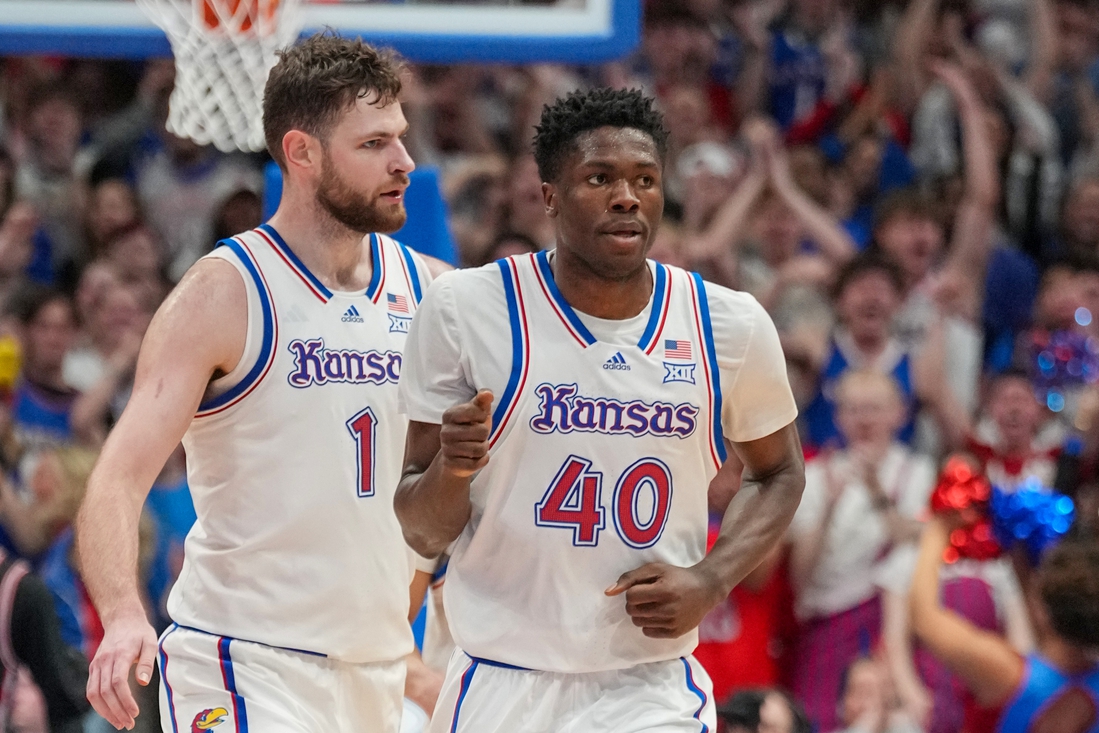
Kansas seemed like they might win, thanks to the strong performance of Alabama transfer Rylan Griffen, who scored a season-high 17 points, hitting 5 of 6 three-pointers. Freshman Flory Bidunga had a career-high 19 points with seven rebounds, and Hunter Dickinson added 17 points and eight rebounds. Dajuan Harris Jr. had a career-high 12 assists.
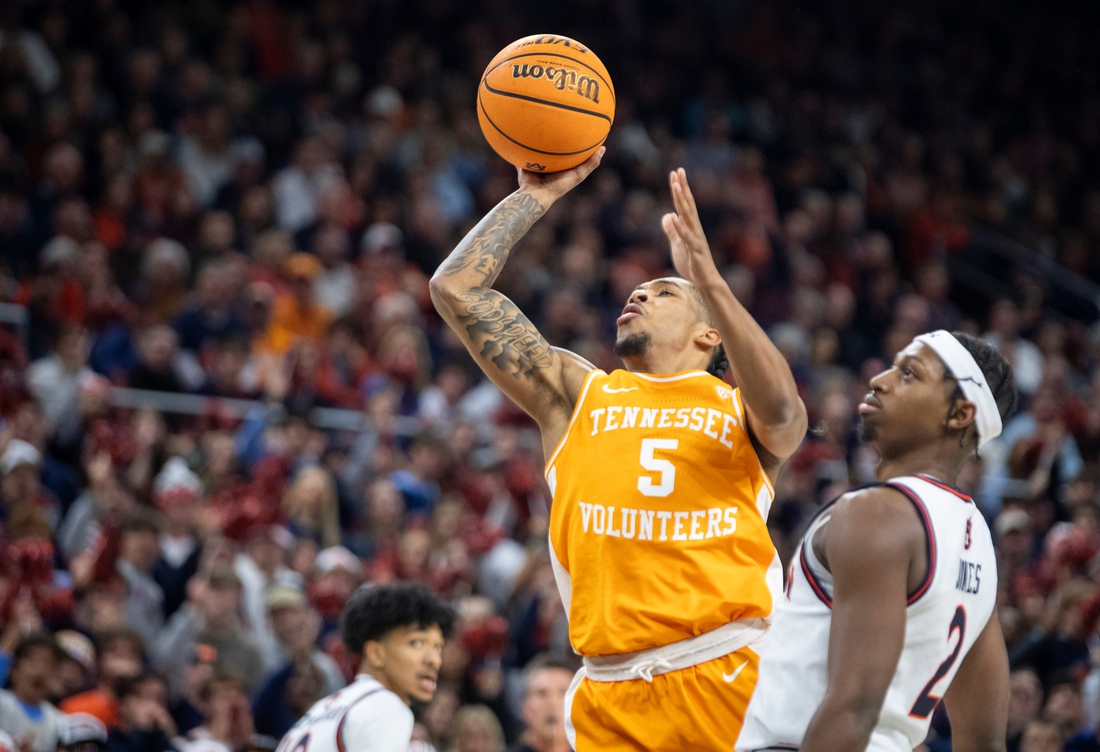
Tennessee (NCAAB)
However, Houston ended the game on a 19-7 run in the two overtime periods.
Kansas missed two free throws with less than 20 seconds left in the first overtime, which could have extended their 79-73 lead. Trailing 79-76, Houston stole an inbound pass in the frontcourt, and with no one in position to foul, Mylik Wilson hit a tying three-pointer with 4.3 seconds left.
UCF is coming off a dominant 85-58 victory over TCU on Saturday. This was their largest margin of victory this season, and more importantly, they allowed the fewest points since December 8, when they gave up 51 to Tarleton State. TCU shot just 1 of 20 from three-point range.
Keyshawn Hall, who scored 26 points and grabbed eight rebounds, said the Knights’ defense will be key to their success. Coach Johnny Dawkins’ team has allowed an average of 83.5 points in their first eight conference games, the worst in the 16-team league.
“We just gotta stay locked in on the defensive end,” Hall said. “If we stay locked in on the defensive end and get back to UCF basketball, like how coach Dawkins’ (teams) usually (played) throughout the years, then we’ll have a big chance because we can score better.”
Tennessee and Kentucky have lost a total of eight games this season, with six of them happening in the last three weeks.
One of these teams will add a fourth loss during that stretch when No. 8 Tennessee hosts No. 12 Kentucky in Southeastern Conference play on Tuesday night in Knoxville, Tenn.
Tennessee (17-3, 4-3 SEC) started the season strong, winning their first 14 games and being the last team in the country to lose. However, they have since gone 3-3, with their most recent loss being a 53-51 road defeat against top-ranked Auburn.
Kentucky (14-5, 3-3 SEC) started with 12 wins in their first 14 games but has now dropped three of their last five, including back-to-back losses against No. 4 Alabama and at Vanderbilt. The Vanderbilt loss also dropped the Wildcats to 10th place in the 16-team SEC.
Kentucky head coach Mark Pope was frustrated with his team’s turnovers in their 74-69 loss to Vanderbilt on Saturday. Kentucky had 17 turnovers, compared to just five for the Commodores.
“We just kept giving them the ball,” Pope said. “We’re one of the top ball protection teams in the country. There’s some spaces in the game where you feel like you have some confidence, but when you start leaking there, the game gets super hard.”
The Wildcats were without forward Andrew Carr (back) on Saturday and may be without him again on Tuesday. Carr is fourth in scoring (10.9 points per game) and second in rebounds (5.6). Carr hasn’t been able to practice due to his back injury.
“He wants to play so bad, but there’s just so much he can’t do with his back,” said Carr. “Every game, it’s like he gets beat up so bad, it’s back to square one, where it’s hard for him to walk.”
Jaylen Carey celebrates a dunk against Kentucky
Kentucky’s leading scorer, Otega Oweh (15.9 points per game), has scored 21 points in back-to-back games and has reached that total five times this season.
Tennessee is currently tied for fifth through ninth in the SEC after struggling with their shooting in the loss to Auburn, where they made only 31.5% of their shots and went 4-for-22 from three-point range.
While Tennessee’s defense was strong, holding Auburn to just 31% shooting and 3-for-20 from beyond the arc, they struggled to score.
“We believe in our defense,” said Tennessee coach Rick Barnes. “We struggle at times like every team in the country struggles to score. It’s not just us. It’s everybody.”
Zakai Zeigler scored 14 points but only made 4 of his 15 field-goal attempts. Chaz Lanier, who scored 10 points, was the only other player to reach double digits. Lanier had a strong start to the season but has been struggling recently, averaging 12.5 points in the last six games while shooting just 30.5% from the field.
“Well, he’s going to have to continue to move, cut, get open,” Barnes said about Lanier. “If he doesn’t get some separation, we’re not going to be able to screen for him. It’s up to us as coaches and him to understand the adjustments that he’s got to make to get open.”
The two teams split their meetings last season, with the road team winning each game. Tennessee won 103-92 on Feb. 3, and Kentucky won 85-81 on March 9.
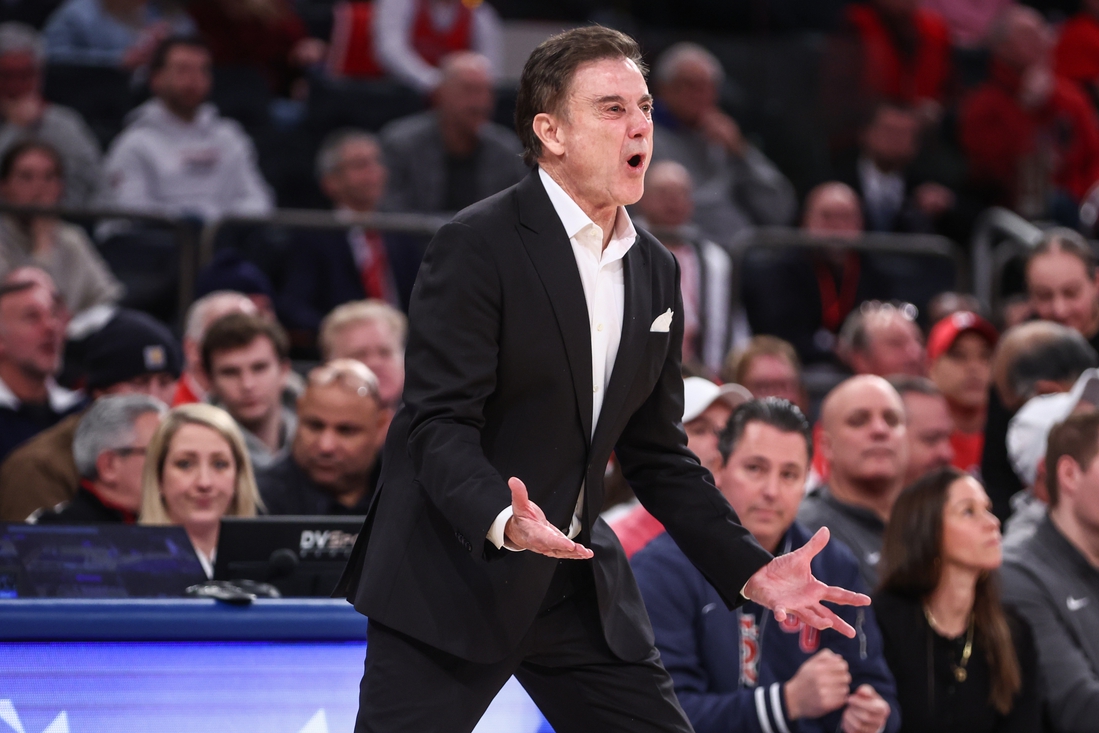
Coach Rick Pitino and No. 15 St. John’s will finish their season series against struggling Georgetown on Tuesday night in Washington, D.C., with the two teams heading in different directions.
The Red Storm (17-3, 8-1 Big East) have won six straight games and are tied with No. 9 Marquette for the top spot in the conference, thanks to strong defense and key performances from Kadary Richmond and RJ Luis.
Their recent success helped them climb five spots in the latest Associated Press Top 25 poll.
Pitino, a Hall of Fame coach, has St. John’s off to its best start in 39 years, and he’s on track to take his sixth different school to the NCAA Tournament after missing out in his first season with the Red Storm.
St. John’s is ranked No. 15 for the first time in a decade, dating back to when Steve Lavin’s team reached that spot during the 2014-15 season.
However, it hasn’t been entirely smooth sailing for St. John’s lately.
In two of their last three games, the Red Storm had to rally from double-digit deficits to keep their win streak alive.
In the first matchup with Georgetown on Jan. 14, St. John’s trailed 35-20 late in the first half but came back to win 63-58, holding Georgetown to just 21 points in the second half on 32 percent shooting.
In their most recent game against Xavier on Wednesday, the Red Storm were down 50-34 with 17:02 remaining but forced overtime and won 79-71 behind Richmond’s 19 points and Luis’ 16, despite shooting just 1 of 12 from three-point range.
“A lot of teams, when they get down 16, get down 14, really hang their heads,” Pitino said after the game. “It’s just the opposite with these guys, and that goes back to their fear of losing, and they just dig in and dig in and played magnificent when the game was on the line.”
Providence and Georgetown (NCAAB)
After starting 3-0 in conference play for the first time since 2012, Georgetown (13-7, 4-5) has lost five of its last six games and fallen to the middle of the Big East standings.
Despite an improved defense in Ed Cooley’s second season, offense has been a struggle for Georgetown recently.
The Hoyas have been held under 70 points in seven straight games, going 2-5. They’ve scored more than 70 points just once in Big East play — a 81-57 win over Creighton on Dec. 18.
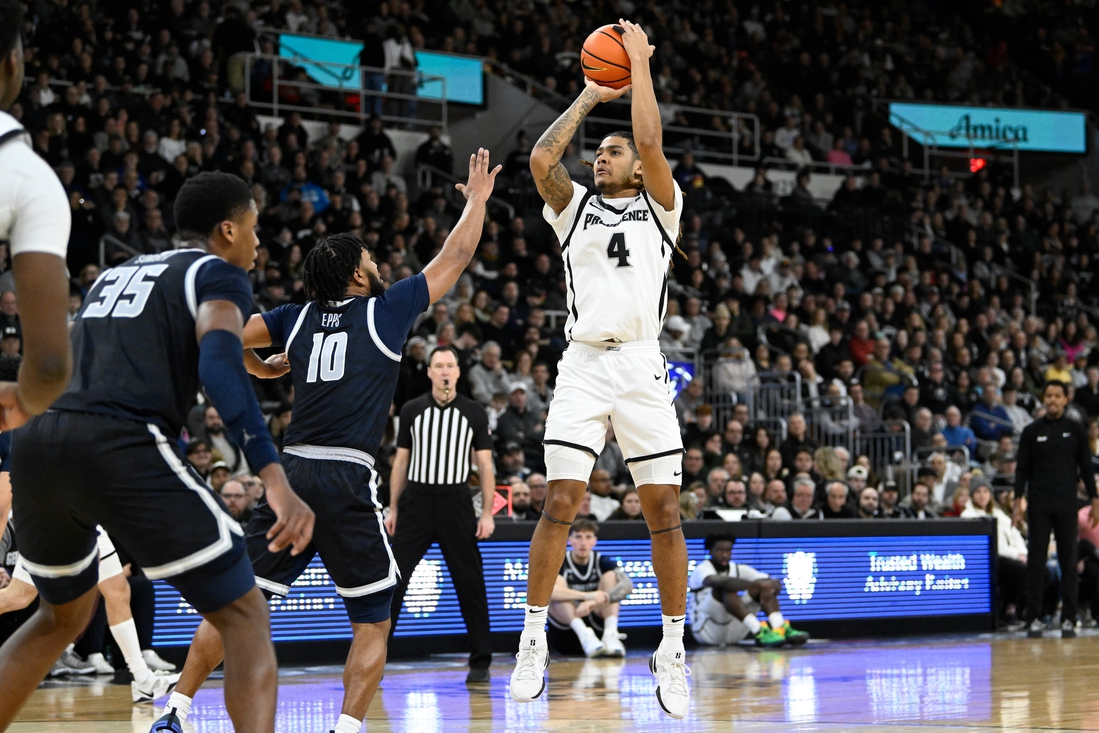
Some of the struggles can be attributed to injuries to Thomas Sorber, who leads the team with 14.8 points per game, and Jayden Epps, who averages 12.9 points. Both players returned to the starting lineup in a 78-68 loss to Providence on Saturday. Sorber finished with 25 points and 15 rebounds, while Epps had six points.
For the first time this season, Cooley said he thought his team’s defense let them down. Georgetown was outrebounded 21-18 on the defensive glass and 37-32 overall.
“This was the first game we played all year where I thought our defense let us down,” Cooley said. “I don’t think we were gritty, and I thought that Providence was tougher.”
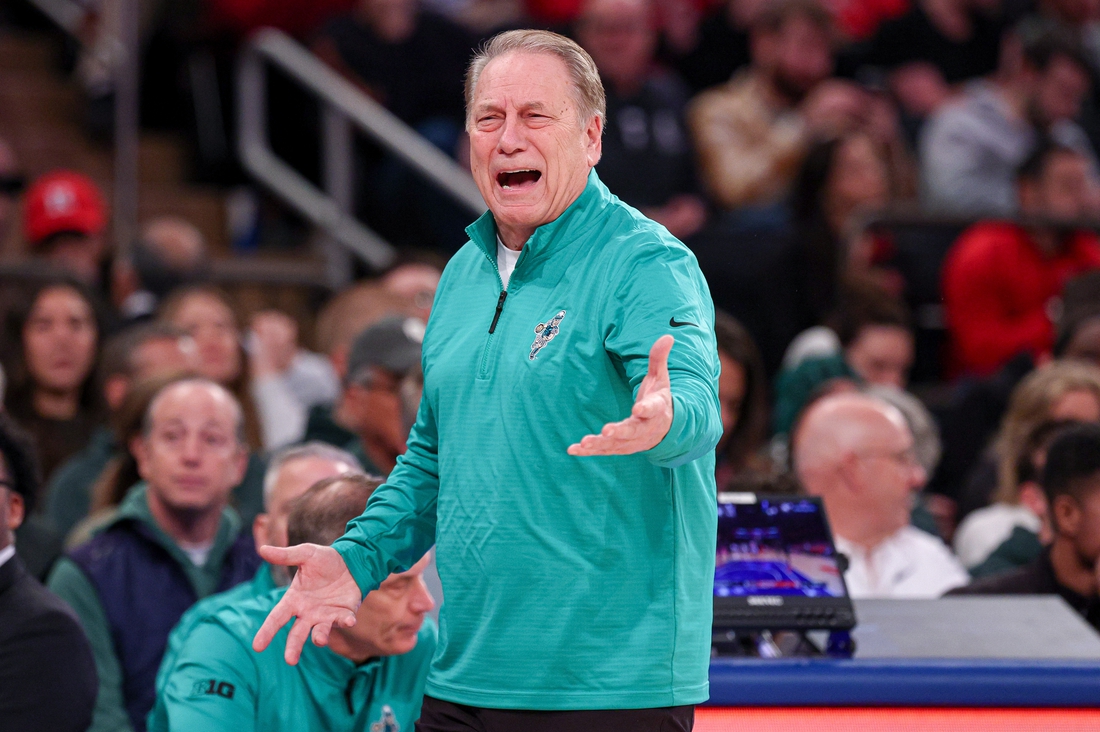
Tom Izzo might have expected to praise his team given No. 8 Michigan State’s 12-game winning streak, but he found some things to work on after their recent 81-74 win over Rutgers.
Izzo is looking for improvement when Michigan State (17-2, 8-0 Big Ten) faces Minnesota (11-9, 3-6) on Tuesday night in East Lansing, Mich.
His message to the team is clear: Don’t get too comfortable with how they are playing.
“I thought for the first time, we looked a little more entitled,” Izzo said. “We looked like we were reading our own press clippings. We did not move the ball smoothly. We looked a little selfish.
“This is a new thing for these guys, too. Learning how to deal with failure is hard. Learning how to deal with success is sometimes harder.”
Minnesota will try to spoil Michigan State’s perfect home record. The Golden Gophers have beaten ranked teams twice in their last three games and hope to extend their streak.
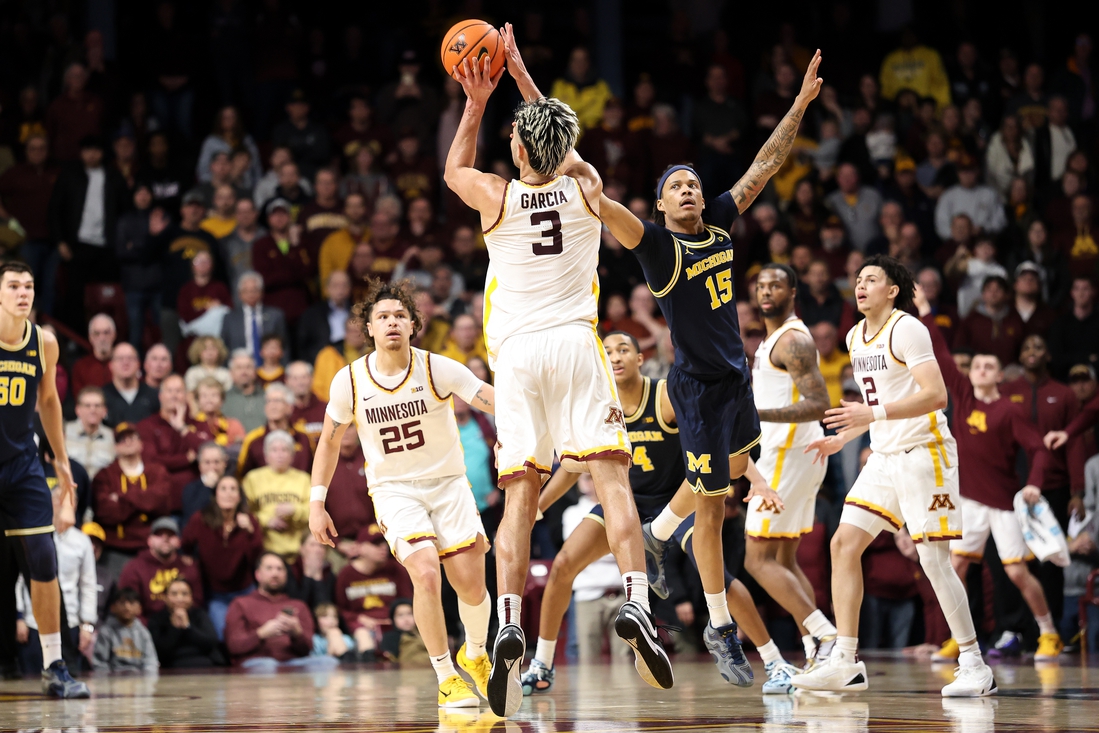
Minnesota defeated No. 15 Oregon 77-69 on Saturday, marking their third consecutive win. They also beat No. 20 Michigan and Iowa in their recent run.
Dawson Garcia has been leading the way for Minnesota, averaging 19.7 points and 7.4 rebounds per game, with a shooting percentage of 49.8%.
Minnesota and No. 20 Michigan
“(He’s the) ultimate competitor,” said Minnesota coach Ben Johnson. “He’s brought everybody up to his level. That’s been a huge part of what we’re doing here. He’s forced with his play for everybody to elevate and have a new standard.”
Michigan State relies on a balanced scoring attack, with nine players averaging over 5 points per game. Jaden Akins leads the team with 13.8 points, followed by Jase Richardson at 9.8.
The Spartans will look to remain perfect at home, where they are 10-0 this season. Minnesota, on the other hand, has a 1-3 record on the road, but their lone win came in their last away game against Iowa.
Izzo is confident his team will continue to improve as the season goes on.
“We’re just trying to stay the course, but it’s hard,” Izzo said. “It’s hard on coaches and it’s hard on players. Because a lot of times — you see it in the NBA, you see it in the NFL — the best players don’t always win games. You’ve got to have that (set of intangibles), and the only way you can get it — the chemistry, the camaraderie — is to play together. I think they’ve done a pretty (darn) good job.
“… I think this team is going to get better. This team will be a tough out by the end of the season.”