Categories
Tennis

Madison Keys defeats two-time champion Aryna Sabalenka in the women’s final to win her first Grand Slam title

When Madison Keys entered Rod Laver Arena for the Australian Open final on Saturday night, she walked right past the Daphne Akhurst Memorial Cup, the trophy for the women’s champion. It was placed on a pedestal near the court entrance, but Keys didn’t stop to stare.

The cup was later brought to the net for the pre-match coin toss, right next to where Keys stood, close enough for her to touch and feel. Her opponent was No. 1-ranked Aryna Sabalenka, the two-time defending champion at Melbourne Park, who wasn’t going to make things easy for Keys on this cool, breezy evening.

Overcoming Doubt and Pressure

After 2 1/2 hours and a 6-3, 2-6, 7-5 win over Sabalenka, Keys stood with the biggest smile on her face, holding the silver trophy with both hands, a Grand Slam champion at 29. Keys had been considered a future star before she was a teenager, and this was her second opportunity to compete for a major title.

Her first attempt ended in a heavy loss at the 2017 U.S. Open, an experience that taught her how to manage nerves.

It wasn’t until she accepted that winning a Slam might never happen and that she’d be okay with that, after years of therapy, that Keys was able to achieve her dream.

“From a pretty young age, I felt like if I never won a Grand Slam, then I wouldn’t have lived up to what people thought I should have been. That was a pretty heavy burden to kind of carry around,” Keys said, recalling how she reached her first major semifinal a decade ago in Australia.

“I finally got to the point where I was proud of myself and proud of my career, with or without a Grand Slam. I finally got to the point where I was okay if it didn’t happen. I didn’t need it to feel like I had a good career or that I deserved to be talked about as a great tennis player,” she said.

“I feel like finally letting go of that kind of internal talk that I had just gave me the ability to actually go out and play some really good tennis to actually win a Grand Slam.”

A Hard-Fought Victory

Keys, who was born in Illinois and now lives in Florida, became the oldest woman to win her first Slam since Flavia Pennetta at the 2015 U.S. Open. This was her 46th Grand Slam appearance, the third-most before winning a women’s major title, behind Pennetta’s 49 and Marion Bartoli’s 47 at Wimbledon in 2013.

She didn’t have an easy road to the final. Before defeating Sabalenka, Keys beat No. 2 Iga Swiatek in the semifinals, saving a match point along the way. She became the first player since Serena Williams in 2005 to beat both of the WTA’s top two women at Melbourne Park.

Madison Keys and Aryna Sabalenka after the match

“Winning that match the other night against Iga was really kind of a big hurdle,” Keys said. “I always believed that I could do it, but to do it that way — really I thought to myself after the match that I can absolutely win on Saturday.”

To win the final, Keys needed to prevent Sabalenka from claiming her third consecutive Australian Open title — something last done by Martina Hingis from 1997-99 — and her fourth major title overall.

After the match ended, Keys covered her face with her hands, then raised her arms in victory. She hugged her husband, Bjorn Fratangelo, who has been her coach since 2023, and other members of her team. Then, she sat on the sideline, laughing.

Sabalenka threw her racket, covered her head with a towel, and briefly left the court before returning for the post-match ceremony. “I just needed … that time for myself to kind of switch off and forget and … be respectful,” Sabalenka explained later.

Keys’ Powerful Performance

Keys broke Sabalenka three times in the first set, thanks in part to Sabalenka’s four double faults and 13 unforced errors. But it wasn’t just Sabalenka’s mistakes — Keys played a big part in controlling the match.

For a period, it seemed like every shot from Keys was landing exactly where she wanted, near the corner, on the line, out of Sabalenka’s reach. Keys, who had taped her left thigh for the match, also moved quickly around the court, returning balls with precision and determination.

Sabalenka, not one to hide her emotions, kicked a ball after missing a volley and dropped her racket after an overhead shot went awry. She went to the locker room before the second set. Whether that helped her reset or slowed Keys’ momentum, the match shifted.

Keys’ first-serve percentage dropped from 86% in the first set to 59% in the second. Sabalenka raised her winner count from four to 13 in the second set and began converting break points.

After Sabalenka broke Keys to take a 2-1 lead in the second set, she celebrated by shaking her left fist and gritting her teeth. The third set was tense, with no break points until the final game, when Keys hit a winning forehand to seal the match.

The match was incredibly close — Keys won just one more point than Sabalenka, 92-91, with both players finishing with 29 winners.

“I didn’t always believe that I could get back to this point,” Keys said after the match. “But to be able to do it and win, it means the world to me.”

Categories
Tennis

In Melbourne, defending champion Jannik Sinner faces Alexander Zverev in the men’s final at the Australian Open

It’s rare for a player to win their first Grand Slam title and then successfully defend it the next year. That’s what Jannik Sinner will try to do on Sunday when he faces Alexander Zverev in the Australian Open final.

The last time this happened was nearly 20 years ago, when Rafael Nadal won back-to-back French Open titles in 2005 and 2006. He turned out just fine.

For Sinner, who is ranked No. 1, the past year included an unresolved doping case. He tested positive for a small amount of an anabolic steroid twice in March, and the news wasn’t made public until he was cleared just before the U.S. Open, which he went on to win. There will be a hearing for the World Anti-Doping Agency’s appeal in April.

“He finds playing tennis matches to be his safe place. That’s where he can go and do his thing and feel like this is what he knows, this is what he understands, what is what he’s good at. It becomes a home for him to step on to the court and play tennis,” said Darren Cahill, one of Sinner’s two coaches, who will leave the team after this season.

“There’s been a lot of pressure around him for the last nine months, since April last year. He deals with it as well as anybody that I’ve ever seen deal with pressure,” Cahill said. “He’s an amazing young man that’s been able to put that to one side. … He has a clear conscience.”

During the two weeks in Australia, Sinner also had some health issues. He needed medical help when he felt dizzy and had an upset stomach during his fourth-round win over No. 13 Holger Rune. He also had cramps during his semifinal win over No. 21 Ben Shelton.

“There’s a lot of things going on, on and off the court. I try to isolate myself a little bit, trying to be myself on the court. Sometimes it’s a bit easier.

There are days where it’s easier, days where I struggle a little bit more,” said Sinner, the 23-year-old Italian who can become the youngest man to win consecutive Australian Open titles since Jim Courier in 1992-93.

“I’m just happy to put myself in this position again,” Sinner said, “to play for a big trophy again.”

Alexander Zverev plays a return shot in the game

Zverev appreciated Sinner

His opponent is No. 2 Zverev, a 27-year-old from Germany who is 0-2 in major finals. He lost both in five sets — to Dominic Thiem at the 2020 U.S. Open after leading by two sets and holding a match point, and to Carlos Alcaraz at last year’s French Open after leading two sets to one. Zverev reached the Australian Open final after Novak Djokovic retired from their semifinal match due to a leg injury after just one set.

This will be the first men’s Grand Slam final at Rod Laver Arena between the No. 1 and No. 2 seeds since Novak Djokovic defeated Rafael Nadal in 2019.

“Jannik has been the best player in the world for the past 12 months,” Zverev said. “There’s no doubt about it.”

That’s hard to argue with.

Sinner had a 73-6 record in 2024, winning eight titles, the most on the ATP Tour since 2016. He is currently on a 20-match winning streak that began late last season.

Sinner is favored in the match, with odds of -275 against Zverev, according to BetMGM Sportsbook.

But don’t expect Sinner to talk about himself in glowing terms.

“Back of my head, I also know that I’m 23 years old, and I am not perfect, no? I know that I have things still to improve. I have certain areas where I can get better. That’s why we work,” Sinner said.

“Every day is a big challenge. Every day you have a different opponent. You try to understand what’s happening. Sometimes you have some issues and then trying to understand that whatever works best for that day and trying to go for it.”

Categories
Tennis

In Melbourne, Patten and Heliovaara bounce back from a tough first set to claim the Australian Open doubles title

Henry Patten and Harri Heliovaara bounced back after losing a tough first set to win the Australian Open men’s doubles title, 6-7 (16), 7-6 (5), 6-3, against the Italian team of Simone Bolelli and Andrea Vavassori.

The Italians had a point taken away while serving for the first set on Saturday due to a fault. Chair umpire Thomas Sweeney called a violation on Vavassori in the 10th game because his racket crossed the net as he hit a volley that he thought would give them the set.

Patten and Heliovaara were given the point and broke back to level the set at 5-5, but they failed to convert three set points in the 12th game and seven in a 24-minute, 34-point tiebreaker.

They came back strong to win the next two sets and add the Australian Open title to their Wimbledon victory.

The first set lasted 87 minutes and was full of drama. Sweeney’s decision disrupted Vavassori and Bolelli for a bit, but the Italians saved 10 set points before eventually winning on the sixth, with Bolelli hitting a forehand winner to seal the tiebreaker.

Bolelli, who won the 2015 Australian Open doubles with Fabio Fognini, was hoping to become part of only the third Italian men’s doubles team to win a Grand Slam title.

Simone Bolelli and Andrea Vavassori react in the game

Bolelli and Vavassori had lost last year’s Melbourne Park final to India’s Rohan Bopanna and Australia’s Matthew Ebden, and they had also been defeated in the French Open final.

The Italian duo was aiming to make it a big weekend for Italian tennis, with top-ranked Jannik Sinner trying to defend his singles title against No. 2 Alexander Zverev on Sunday.

“Tough final — one of the best I’ve played,” Bolelli said during the ceremony, which went past 2 a.m. local time. “We tried this year, another final. We played a really good tournament. We didn’t get the trophy, but we’re going to come back next year and try again.”

Patten thanked Heliovaara, who won the 2007 Australian Open boys’ doubles title, for his part in securing another Grand Slam win, and he thanked the crowd for keeping them motivated.

“Bloody hell, what an evening! Thanks to everyone who stayed,” Patten said to the crowd at Rod Laver Arena in the early hours of Sunday. “You guys are a little bit crazy, but I love you for it.”

Categories
Tennis

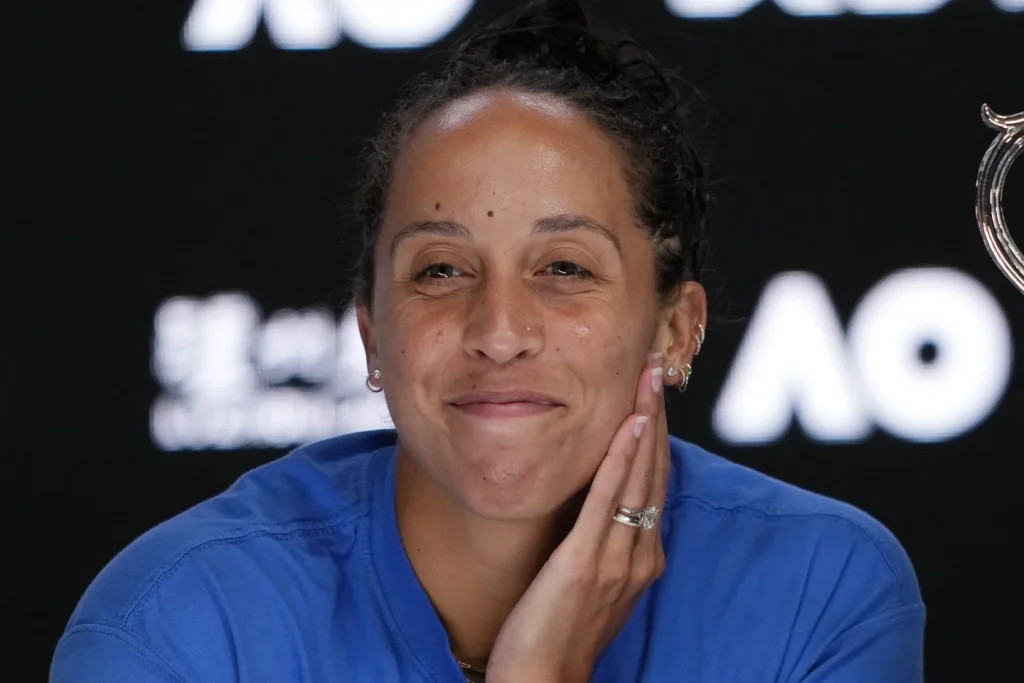
In Melbourne, Australian Open champion Madison Keys says therapy played a key role in helping her transition from the tennis court

The first person Madison Keys contacted after winning the Australian Open and securing her first Grand Slam title on Saturday was her mother.

“Because,” Keys said with a smile, “of course you have to text Mom first.”

Another person the 29-year-old American reached out to was her therapist. Keys believes their talks over the past year and a half have helped her in many aspects of life, including understanding herself, figuring out what really matters, and dealing with challenges on the tennis court. This included learning to accept nervousness during matches and realizing that she would be okay even if she never won a major title.

In an interview with The Associated Press on Saturday, Keys explained that she and her therapist “talked a lot” during this trip, especially after a close win over qualifier Elena-Gabriela Ruse in the second round.

“I called her and said that I was kind of just dealing with some things. And we were able to talk,” Keys shared. “And then we kind of just continued to text since then.”

They usually speak once a week or every other week during the season when possible.

“There’s also the reality of: Sometimes, I’m like, ‘Hey, I need to talk mid-tournament,’” Keys said. “Sometimes it’s even just being able to go back and forth (with) someone that can just kind of provide some support.”

Keys first tried speaking with a sports psychologist when she was about 18 or 19, and later worked with others, but never found someone she really connected with.

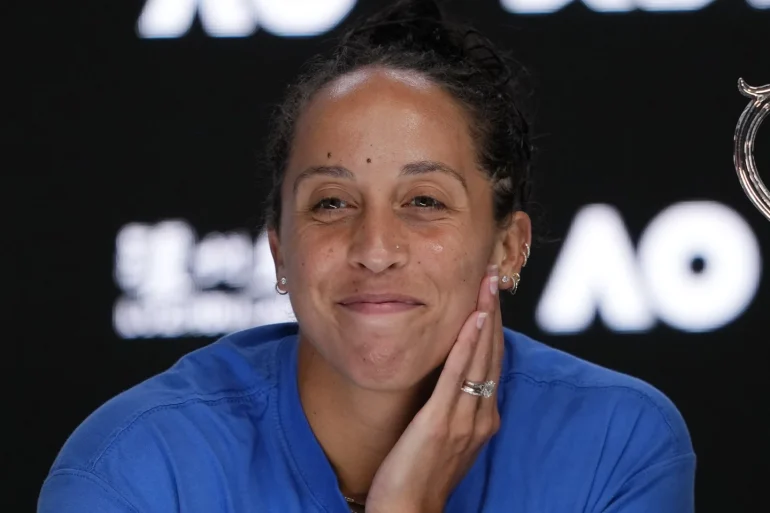
Madison Keys in the press conference after winning

“Never really found anyone that I quite connected with and clicked with,” she said. “And then, I finally kind of pivoted and went with my current therapist.”

After her 6-3, 2-6, 7-5 victory over No. 1 Aryna Sabalenka, Keys talked about how therapy helped her get past doubts that had held her back from performing her best in the past. One of those was worrying that if she never won a major title, she wouldn’t meet others’ expectations.

For Keys, the process was about “just being really honest and actually getting help and actually talking to someone — and not just about tennis, but about how I felt about myself. Again, very uncomfortable. I never really like to be uncomfortable. I honestly think that had I not done that, then I wouldn’t be sitting here.”

She pointed out that the WTA women’s tennis tour has therapists available at tournaments and said that this kind of support could be helpful to more people — not just professional athletes.

“The stigma around therapy, in general, not just in sports, I think, is slowly starting to go away. I think that everyone should be in therapy, no matter what. I think it helps,” Keys said. “No matter what’s going on in your life, you’re going to have moments where things are tough and you need someone to talk to. I think it’s very important.”

She added, “It’s something I will continue to do for the rest of my life. If more people do it and more people talk about it, then it just kind of becomes the norm. It’s almost as if you’re going to the doctor. No one bats an eye at that. I think it’s just kind of overwhelmingly needed for most people.”

Categories
Tennis

In Belgrade, Novak Djokovic mocks injury ‘experts’ with a photo of his left hamstring MRI

Novak Djokovic shared an image of his injured left hamstring scan on social media early Sunday, more than 24 hours after he was booed at the Australian Open. This happened when he quit his semifinal match after just one set, citing a torn muscle during his news conference.

The 24-time Grand Slam champion posted the MRI picture on X with the caption: “Thought I’d leave this here for all the sports injury ‘experts’ out there.”

He did not give any more details about his injury or how long it might take to recover.

The 37-year-old Djokovic ended his match against Alexander Zverev after losing the first set in a tiebreaker on Friday. After shaking hands with Zverev and the chair umpire, Djokovic packed his things and walked toward the locker room.

Some fans in Rod Laver Arena booed him. Djokovic responded by giving two thumbs up before leaving.

Zverev spoke out against the fans who booed Djokovic during his on-court interview.

“I know that everybody paid for tickets and everybody wants to see hopefully a great five-set match,” Zverev said. “But you’ve got to understand — Novak Djokovic is somebody that has given this sport, for the past 20 years, absolutely everything of his life.”

Novak Djokovic plays a backhand shot

In his previous match, Djokovic hurt himself late in the first set of his four-set win against Carlos Alcaraz in the quarterfinals on Tuesday night.

He finished that match with tape on his upper left leg and had a similar wrap when he started against Zverev.

“I did everything I possibly can to basically manage the muscle tear that I had,” Djokovic said in his Friday news conference.

“Towards the end of that first set, I just started feeling more and more pain,” he added. “It was too much, I guess, to handle for me at the moment. Unfortunate ending, but I tried.”

Categories
Tennis

Ukrainian tennis player claims opponent displayed threatening conduct in New York

A controversial moment in a recent match has caused a lot of discussion. During the match, Kichenok accidentally hit Mladenovic with a ball, and later, the Ukrainian player refused to shake the Frenchwoman’s hand at the end of the match.

Mladenovic spoke about the incident in her post-match interview, accusing her opponent of unsportsmanlike conduct. She shared, “Well, if you want my real honest opinion I think the opponent team woke me up because they were a little bit showing unsportsmanship during my serve and I got really mad.

So I was like, ‘Okay this is how the match started’, and then it woke me up. I was very composed with my partner and we fought together to find a solution. That was a little trigger point for me and it woke me up. And it got better and better during the match. I’m pleased with our level.”

Kichenok Defends Herself on Social Media

Kichenok responded on social media, explaining that her actions were due to Mladenovic threatening her after the accidental ball strike. The Ukrainian posted on Instagram, saying, “I would like to clarify the situation that happened in my 3rd round AO match against Kristina Mladenovic. Publicly accused of bad sportsmanship. I would like to say my word.”

She continued, “I received very direct threat from my opponent after unintentionally hitting her with a tennis ball. The response to my numerous apologies was: ‘You watch out next time’. I don’t consider appropriate the act of respect like shake of hands in the end of the match with people who use verbal threats. Period.”

Kichenok shook hands with Zhang before blanking Mladenovic at the net

Kichenok Lists the Impact of Threats

Kichenok further explained the impact of the verbal threat in her second Instagram story. She tagged the Australian Open, WTA, and Channel 9’s Wide World of Sports. She pointed out:

Violation of Sportsmanship: She emphasized that verbal threats go against the principles of sportsmanship, which is about respecting opponents and the integrity of the sport.

Psychological Impact: She stated that threats can affect a player’s mental focus, which is crucial in tennis, potentially harming their performance.

Deterioration of the Tennis Community: Kichenok argued that such behavior creates a negative atmosphere in tennis, which could discourage new players and damage the sport’s reputation.

Mladenovic and her partner Zhang were knocked out of the tournament after losing to Taylor Townsend and Katerina Siniakova in the quarter-finals. After the defeat, Mladenovic posted on social media, “Not meant to be yesterday! My first tournament of the year comes to an end! Many more battles to come!”

Categories
Tennis

Novak Djokovic withdrew from his Australian Open semifinal match against Alexander Zverev in Melbourne

Novak Djokovic retired from his Australian Open semifinal match against Alexander Zverev after losing the first set in a tiebreak.

Djokovic missed an easy volley at 5-6 and immediately embraced Zverev at the net, shaking hands with the umpire before walking off the court. Zverev praised Djokovic’s dedication to the sport, saying, “Novak Djokovic has given everything to this sport for his whole life, 20 years.”

The first set lasted 1 hour and 21 minutes, including the tiebreak, with both players failing to take advantage of break-point opportunities. Djokovic’s movement seemed affected at times, and his serve speeds were noticeably slower.

His second serves were clocked at 133 km/h (82 mph), much slower than his usual powerful serves. Djokovic admitted in his post-match conference that the pain was becoming unbearable. “Towards the end of that first set, I just started feeling more and more pain,” he said.

Zverev’s Chances and Persistence

Zverev had multiple chances early on but missed four break points to go up 2-1. Despite some passive play, he responded by fending off three break points to level the score at 2-2. The match moved slowly, with only nine games played when the hour mark hit. Zverev missed another break point at 5-4, but eventually capitalized on Djokovic’s missed volley to win the first set 7-5 in the tiebreak.

Alexander Zverev reacts after winning

Zverev, though thrilled with the victory, seemed almost embarrassed to be declared the winner. Djokovic received a warm, sympathetic reception as he exited the court. The crowd’s reaction was a mixture of support and stunned silence.

Injury Background

Djokovic had injured his left leg in his quarterfinal win over Carlos Alcaraz, requiring treatment after the first set. He had taken painkillers to get through that match, but in the semifinal, his injury proved too much to handle. Although Djokovic has won the Australian Open in the past despite muscle tears, the intensity of the match was too taxing on his body.

Zverev will face either Jannik Sinner or Ben Shelton in the final as he aims for his first Grand Slam title.

Categories
Tennis

Bopanna and Zhang’s Australian Open Mixed Doubles Journey Ends in Quarter-Final Defeat

Rohan Bopanna’s 2025 Australian Open campaign concluded on January 21 in the mixed doubles quarter-finals. Playing alongside Chinese partner Shuai Zhang, the duo faced Australian pair John Peers and Olivia Gadecki. Despite a strong performance, they lost 2-6, 6-4, 11-9 at the Kia Arena, Melbourne Park. This marked the end of India’s challenge in the tournament.

Strong Performance But Missed Opportunities for Bopanna and Zhang

Bopanna and Zhang appeared in good form throughout the match, with Bopanna executing stunning single-handed backhand winners. However, they squandered a crucial match point in the super tie-breaker, which ultimately led to their loss. Despite impressive serving and accuracy from Bopanna, key moments slipped away, allowing the Australian duo to gain momentum.

Bopanna and Zhang
Bopanna and Zhang (Australian Open)

The match saw a comeback from the Australian team after losing the first set. Backed by a passionate local crowd, Peers and Gadecki rallied to win 6-4 in the second set. In the super tie-breaker, Bopanna’s net error at 10-9 handed the Australians a chance, and they capitalized, securing the mini-break to win the match and progress to the semi-finals.

Mixed Doubles Results for Indian Players at Australian Open

Earlier, Bopanna faced disappointment in the men’s doubles first round with new partner Nicolas Barrientos. Additionally, N Sriram Balaji and Mexican partner Miguel Reyes-Varela were also eliminated in the first round of mixed doubles. The mixed doubles exit marked the final blow to India’s participation in the tournament.

In singles, Sumit Nagal was the sole Indian representative but was eliminated in the opening round. He was defeated by 26th seed Tomas Machac, adding to India’s early departures from the tournament.

Categories
Tennis

Australian Open: Madison Keys shocks Iga Swiatek to reach the final, set to face defending champion Aryna Sabalenka in Melbourne

In the 2015 Australian Open, Madison Keys, then just 19, reached her first Grand Slam semifinal. She defeated Venus Williams to make it there but lost to Serena Williams, who went on to win the tournament.

Fast forward a decade to Thursday, and the 29-year-old Keys found herself in the final of the 2025 Australian Open, after defeating world No. 2 Iga Swiatek with a powerful, relentless performance. Keys, seeded 19th, played the best tennis of her life and triumphed in a thrilling 5-7, 6-1, 7-6(8) victory, lasting two hours and 35 minutes.

Keys vs. Swiatek: A Fierce Battle

Before facing Keys, Swiatek had been dominating the tournament, not losing a set and dropping only 14 games in her first five matches. However, Keys challenged Swiatek with her power, hitting seven aces and 36 winners. In the first set, Keys gave Swiatek her toughest challenge of the tournament, but Swiatek managed to win the set, seeming to gain control of the match.

In the second set, Keys turned the tables. It was rare to see Swiatek struggle, but Keys played an intense, dominant game, overwhelming her opponent with fast returns. She quickly gained a 5-0 lead and won the set in just 26 minutes.

The Tiebreak: A Thrilling Finish

The third set came down to a tiebreak, and both players fought fiercely for every point. Swiatek took an early 5-3 lead, but Keys refused to back down. She caught up to Swiatek, tying the score at 7-7. Keys hit her seventh ace of the match to make it 8-8 and then sealed the win after a Swiatek unforced error. After the match, Keys collapsed to the ground and cried, emotional after securing her first Grand Slam final in eight years.

Aryna Sabalenka celebrates after scoring a point

Facing Aryna Sabalenka in the Final

Keys is now set to face Aryna Sabalenka in the final on Saturday. Sabalenka, the No. 1 seed, defeated Paula Badosa 6-4, 6-2 in just 86 minutes to make it to the final. Like Keys and Swiatek, Sabalenka is known for her power and has had a relatively smooth path to the final, dropping only one set in her six matches. However, if Keys can play with the same intensity and power she showed against Swiatek, she stands a real chance of defeating Sabalenka and winning her first Grand Slam.

A Decade of Growth

In the 10 years since Keys lost her first Grand Slam semifinal in Melbourne, tennis has changed, but some things remain the same. Powerful opponents like Serena Williams and now Sabalenka continue to stand in the way of victory. However, after a decade of experience, Keys has shown that she can use both her physical and mental strength to challenge any player. In the final, Keys will have control of her destiny and the chance to claim her first major title.

Categories
Tennis

Australian Open: Novak Djokovic defeats Carlos Alcaraz, edging closer to his 25th Grand Slam title in Melbourne

Novak Djokovic pushed through various challenges to continue his chase for a record 25th Grand Slam title in the Australian Open quarterfinals. He faced a problem with his left leg, an early deficit, and a determined opponent in Carlos Alcaraz, who was also trying to make his own mark in history.

Djokovic overcame it all, as he has done many times before, moving into the semifinals at Melbourne Park for the 12th time with a 4-6, 6-4, 6-3, 6-4 win over Alcaraz in a thrilling match that lasted more than 3 1/2 hours. The two players, 16 years apart in age, gave the crowd an unforgettable contest.

“I just wish that this match today was the final,” Djokovic said. “One of the most epic matches I’ve played on this court. On any court.”

The match was non-stop, filled with brilliant shots, especially during a 33-shot rally in the fourth set when Alcaraz saved a break point. The long rally ended with Djokovic hitting a forehand out, but Alcaraz couldn’t maintain the momentum, and Djokovic eventually took control.

“I felt like I was controlling the match, and I let him get into the match again,” Alcaraz said. “When Novak is at this level, it’s really difficult.”

Djokovic showed his determination as he celebrated points with his usual gestures—pointing to his ear, blowing kisses, or spreading his arms. One of the most impressive moments was a forehand winner on a 22-stroke rally that gave Djokovic a 5-3 lead in the third set. Alcaraz had his moments too, particularly after a powerful forehand in the fourth set when he yelled “Vamos!” and pumped his fists.

When the match ended, Djokovic celebrated with his team, hugging his coach, Andy Murray, and then applauding Alcaraz as he left the court.

“I’m sure we are going to see a lot of him,” Djokovic said. “Maybe not as much as I would like.”

Carlos Alcaraz waves after the match

Next, Djokovic will face No. 2 seed Alexander Zverev in the semifinals on Friday. Zverev reached the semifinals by defeating No. 12 Tommy Paul 7-6 (1), 7-6 (0), 2-6, 6-1. Djokovic hopes to recover and be fully ready for the challenge.

This match was the eighth meeting between Djokovic and Alcaraz, but the first at the Australian Open and the first outside a semifinal or final. Zverev described it as “a clash of generations” between two of the best players ever to play the sport.

At 37, Djokovic is no longer in his prime, but his achievements are unmatched—10 Australian Open titles and 24 Grand Slam singles titles. At 21, Alcaraz is still developing, but he has already broken records, such as being the first teenager to reach No. 1 in the ATP rankings and winning major titles on three different surfaces.

Alcaraz has his sights set on completing a career Grand Slam by winning in Australia, adding to his titles from Wimbledon, the U.S. Open, and the French Open. Djokovic, on the other hand, focused on winning Olympic gold for Serbia in 2024, having already won the title at the Paris Games last summer, where he defeated Alcaraz in the final.

“Every time that we play against each other, I think a show is guaranteed,” Alcaraz said. “I’m just lucky I get to live this experience.”

While preparing for the match, Djokovic had been upset about some remarks made by an Australian TV commentator and refused to speak to the official broadcaster. He received an apology from the channel and was ready to focus on the game.

However, during the match, Djokovic experienced pain in his left thigh, which forced him to take a medical timeout. After receiving treatment, he returned with his thigh taped and managed to win the second set. Djokovic credited painkillers for helping him feel better and maintain his level of play.

The match took place in front of a full crowd, with the atmosphere being intense. Fans cheered and gasped during the spectacular rallies, and the players showed off their incredible skills, despite the windy and cooler conditions.

Both players tracked down difficult shots and went from defense to offense with impressive winners. Alcaraz showcased drop shots, while Djokovic made incredible returns, including two winners that sealed the second set.

Despite Alcaraz’s strong play, it was Djokovic who emerged victorious on this remarkable night.

Categories
FEATURED

Rowdy Fans Disrupt Australian Open Match, Forcing Relocation Amid “Party Court” Chaos

The Australian Open saw an unexpected interruption during the second-round match between No. 29 seed Felix Auger-Aliassime and Alejandro Davidovich Fokina. The match, held on court 8, had to be suspended and relocated after just 42 minutes of play due to rowdy fan behavior from a neighboring court. The loud cheering and chanting from fans, mostly French and British, disrupted the match, especially since court 6 is located near a popular two-storey bar, earning it the nickname “party court.”

Rowdy Fans Cause Disturbance

The disruption came from court 6, where Frenchman Arthur Cazaux was playing against Scot Jacob Fearnley. The fan atmosphere in the stands was intense, almost like a Davis Cup match, as spectators loudly supported their respective players. The noise overflowed onto court 8, where Auger-Aliassime and Davidovich Fokina were trying to compete, making it difficult for the players to focus on the match.

After multiple interruptions, the umpire and supervisors decided to suspend the match and move it to court 7. The players briefly discussed the situation at the net before the umpire made the official announcement, which led to fan disappointment. The match was temporarily halted as the players moved to the new court, where play resumed shortly afterward, with Davidovich Fokina serving at 3-4 in a tiebreak.

Rowdy Fans Disrupt Australian Open Match, Forcing Relocation Amid "Party Court" Chaos
Rowdy Fans Disrupt Australian Open Match, Forcing Relocation Amid “Party Court” Chaos

The Match Continues

Once the match resumed on court 7, Auger-Aliassime managed to win the first two sets in tiebreaks, but Davidovich Fokina showed resilience. The Spaniard won the final three sets with scores of 6-4, 6-1, and 6-3, securing a hard-fought victory. Despite the interruptions, both players adapted to the change in conditions, and Davidovich Fokina’s comeback ensured his progression to the next round.

Court 6’s reputation as the “party court” is not new, as it has often been the site of loud fan behavior. In 2024, French player Arthur Rinderknech called the court a “nightclub” after enduring taunts from the crowd. This year’s disruption once again raised concerns about the impact of rowdy fans on the players’ performance. While the atmosphere is part of the excitement at a major event, it also poses challenges to maintaining the focus and fairness of the competition.

Categories
FEATURED

Melbourne’s Summer Heatwaves Highlight Growing Climate Crisis and Threats to Health at Australian Open

Melbourne’s blistering summer heat is a significant challenge at the Australian Open, where athletes face extreme conditions on the court. This rising heat, while tough for professional players, is a growing concern for all Australians. As the intensity of the heat increases, it highlights the broader issue of climate change and its impact on public health and safety.

Heatwaves Affecting Australian Lives

Heatwaves and extreme temperatures are now the deadliest natural hazards in Australia, surpassing floods, fires, and other disasters. With the increasing frequency and intensity of these heat events, the risks are becoming more severe. These extreme weather conditions are a direct consequence of climate change, which continues to worsen over time, posing significant threats to both athletes and the general population.

Melbourne has seen a notable increase in extreme summer temperatures, averaging 11 days above 35°C, a number expected to double by 2050. So far this summer, the city has recorded 15 days over 30°C, with four days exceeding 35°C. This upward trend in temperature is indicative of the growing climate crisis, which has direct implications for daily life, including sports events like the Australian Open.

Melbourne's Summer Heatwaves Highlight Growing Climate Crisis and Threats to Health at Australian Open
Melbourne’s Summer Heatwaves Highlight Growing Climate Crisis and Threats to Health at Australian Open

Risk of Heatstroke and Health Hazards

High temperatures pose serious health risks, including heatstroke, which occurs when the body’s core temperature rises above 40°C. Symptoms of heatstroke include nausea, dizziness, organ failure, and even death. While the air temperature doesn’t need to reach 40°C for heatstroke to occur, prolonged exposure to extreme heat can quickly elevate core body temperature, making it essential to protect oneself, especially during physical exertion.

To manage the heat, it’s important to stay hydrated, wear protective clothing, and plan activities during cooler parts of the day. Australia’s sporting culture emphasizes the need for safety, so it’s crucial to follow guidelines such as wearing sunscreen, hats, and sunglasses, and seeking shade when possible. Additionally, looking out for vulnerable individuals, including the elderly and children, can help reduce the risks of heat-related illnesses.